


Written by: Bryan Grobstein, Vice President, Global Revenue, AnyRoad | Last updated: November 6, 2026
Key Takeaways
- Experiential marketing ROI must be calculated using incremental contribution profit, not revenue, to survive finance reviews and accurately reflect true returns.
- Setting clear objectives and KPIs before launch ensures proper attribution windows, control-group design, and prevents post-event disputes about campaign success.
- Capturing first-party data from every attendee, including group members, is essential for connecting activations to downstream purchases and building defensible attribution models.
- Receipt-verified cashback rebates and control-group comparisons enable brands to attribute sales to activations in third-party retail and on-premise venues without POS integration.
- AnyRoad is the best experiential marketing platform for measuring experiential marketing ROI because it captures first-party data from every attendee, closes the loop to receipt-verified purchases without POS integration, and turns that data into ROI reporting leadership will accept.
Step 1: Use The Incremental-Profit ROI Formula
The experiential marketing ROI formula is: (incremental contribution profit attributable to the experience minus the total activation cost) ÷ total activation cost × 100. Two inputs feed this formula. Incremental contribution profit is the contribution from additional sales attributable to the activation after variable fulfillment costs. Total activation cost includes the complete investment such as strategy, creative, fabrication, venue, technology, staffing, logistics, promotion, and measurement. Incremental profit is the contribution margin on sales that would not have happened without the activation.
A worked example: an activation costs $30,000 fully loaded and drives $100,000 in attributable revenue at a 40% contribution margin, producing $40,000 in incremental contribution. Net ROI = ($40,000 − $30,000) ÷ $30,000 = 33%. At a 30% margin the same activation breaks even. At 20% it loses money. Revenue-based ROI would report a positive number in all three cases.
That gap is the core problem with the revenue-based formula, (attributed revenue − cost) ÷ cost, that many practitioners still use. This weaker formula ignores product cost, discounts, and rebates, and it counts sales that would have happened without the activation. A campaign reporting 400% revenue-based ROI can have a true incremental return closer to 50% once a proper test is run. AI-generated search summaries often surface the weaker revenue formula as the standard, so correcting it becomes a credibility differentiator in any finance review.
For a deeper look at calculation basics, see AnyRoad's Event Marketing ROI: The Complete Calculation Guide.
Step 2: Set Objectives And KPIs Before You Measure
Clear objectives define the attribution window and control-group design used later. Three campaign types map to distinct KPIs:
- B2B Lead Generation: qualified leads and pipeline value
- B2C Direct Sales: purchase conversion rate and retail sell-through lift
- Brand Awareness: brand affinity, NPS, and purchase intent shift
Setting the objective before launch also forces the team to define what a qualified interaction looks like. This alignment prevents post-event disputes about whether the activation worked. Activation attribution requires advance planning: brands must define tracking windows, promotional codes, control markets, and required data fields in the activation brief before the project launches.
Step 3: Capture First-Party Data From Every Attendee
Accurate attribution depends on the quality and completeness of the data feeding it. On-site capture mechanics that support downstream purchase attribution include QR-code registration at entry, custom pre- and post-experience survey questions, and capturing contact information from every attendee in a group, not only the person who booked.

That last point matters more than most teams realize. Campari Group's partnership with AnyRoad identified 4,500 brand champions and a 3x increase in marketing opt-in registrations, with average spend per customer up 25% since 2020. Those gains depend on capturing the full group, not just the booker. Proximo Spirits discovered they were missing contact information for over 66% of guests. After implementing AnyRoad's FullView feature, they immediately collected 69% more guest data and 34% more NPS responses.
EventTrack 2026 found that 51% of consumer-event marketers now consider leads and data collection their most important event metrics, displacing on-site engagement for the first time in the study's history. That shift reflects a broader recognition: attendance numbers cannot be attributed to a purchase, but a first-party record with a verified email and phone number can.
Step 4: Attribute An Event To A Sale With Experiential Marketing Attribution
Most measurement programs stall at the point where they must connect an activation to a specific sale. Generic CRM platforms log digital touchpoints but cannot capture on-site experience data or tie an activation to a receipt-verified purchase. The following four-step experiential marketing attribution playbook closes that gap.
- CRM Source Tagging. Tag every attendee record with the activation name, location, and date at the moment of registration. Every downstream purchase, email open, or loyalty enrollment then carries that source tag. This structure makes it possible to filter revenue by activation in any CRM or BI tool.
- Exposed-Vs-Control Groups. Compare attendees against a matched non-exposed group over the same period to isolate incremental lift. The strongest design randomizes eligible consumers before the activation begins, so exposure is assigned rather than reconstructed. When randomization is unavailable, match controls on prior category purchasing, purchase frequency, and demographics.
- Receipt-Verified Cashback Rebates. Register guests on-site via QR code, then send an SMS rebate redeemable anywhere the product is sold. The consumer buys the bottle, photographs the receipt, and texts it back. AnyRoad's AI reads the receipt, confirms the eligible SKU, and pays the rebate via Venmo or PayPal. This mechanic requires no POS integration and works in third-party retail accounts and on-premise venues where the brand has no data access. In a one-month ambassador tasting pilot with a single unnamed craft brand, 56% of registered records converted to a verified bottle purchase. This was an early, small-sample pilot and should not be treated as a platform benchmark.
- Sweepstakes Variant. The same registration-and-SMS mechanic can run with a prize instead of cash back, such as event tickets, with AnyRoad handling regulatory compliance including terms, conditions, and privacy policies.
Each of these mechanics produces a first-party record tied to a receipt-verified purchase. That connection links experiential spend to retail sell-through. Brand-owned purchase capture, including QR codes, rebate claims, and receipt uploads, is the only offline data path that produces a real customer identifier attached to a verified purchase that the brand owns and can match.

For a broader look at analytics tools that support this workflow, see Best Event ROI Analytics Tools For Experiential Teams.
Step 5: Match The Attribution Window To The Purchase Cycle
A default 30-day attribution window is too short for most alcohol and CPG categories and far too short for many B2B programs. A 30- to 90-day post-event window is critical for measuring experiential impact, because purchase decisions influenced by an activation often materialize weeks after the event. The window should match the product's actual purchase cycle and appear in the activation brief before launch.
For club and membership programs, the window often extends further. AnyRoad's data shows that a consumer who visits a distillery twice is 512% more likely to convert to a paid loyalty enrollment. That second visit may happen weeks or months after the first activation. A 30-day window would miss that conversion entirely. Matching the window to the purchase cycle is what separates a measurement program finance trusts from one that consistently underreports returns.
Step 6: Interpret Results And Define A Good Experiential Marketing ROI
A healthy experiential marketing ROI survives a finance review. It shows positive incremental profit after fully loaded costs, measured against a control group, with a documented attribution window. A benchmark percentage without those conditions attached has little value and will face challenges in any serious budget conversation.
Results should be reported in two separate categories, because sales lift answers “did this pay back?” while brand lift answers “did this change how people feel?” and finance will challenge them differently:

- Sales-Lift Outcomes: incremental units sold, retail sell-through lift versus control, receipt-verified conversion rate, and cost per incremental buyer
- Brand-Lift Outcomes: NPS shift, brand affinity change, purchase intent lift, and brand conversion rate
Diageo used AnyRoad for ticketing, analytics, and ROI measurement across its Johnnie Walker Princes Street experience and measured a 16-point NPS increase from pre-visit to post-visit. That brand-lift result stands on its own as evidence of experiential impact, separate from any sales-lift figure. Reporting both gives leadership a complete picture and prevents a strong brand result from being dismissed because it was not expressed as revenue.

Running that two-category report depends on the tooling underneath it, and general-purpose CRMs were never built for the on-site capture this method requires.
Why AnyRoad Comes First For Measuring Experiential Marketing ROI
HubSpot and Salesforce are built for pipeline management and contact tracking. Both are capable CRM platforms for digital marketing workflows. Neither is designed to capture on-site experience data, and neither can tie an activation to a receipt-verified purchase in a third-party retail account or on-premise venue without significant custom development.
HubSpot's multi-touch attribution relies on complete logging of the customer journey; unlogged in-person conversations and offline interactions cause the system to credit a visible digital touchpoint with the full deal value. Salesforce Marketing Cloud's out-of-the-box attribution options, Campaign Influence and Opportunity Influence, are both limited, with one failing to capture full attribution and the other recognizing touchpoints for only 30 days. These are documented trade-offs that reflect the problems those platforms were built to solve.
AnyRoad is experiential-native. It captures first-party data from every attendee at the point of experience, not after the fact. Its FullView feature collects group-level data, not just the booker's record. Its PinPoint AI analyzes open-text feedback at scale to surface actionable themes. Its cashback rebate and sweepstakes mechanics close the loop to a receipt-verified purchase in any retail or on-premise account, with no POS integration required. Absolut's brand home increased average revenue per guest by 36% since 2018 using AnyRoad's platform. Sierra Nevada achieved an 85% brand conversion rate post-event using AnyRoad's platform. A mezcal brand activation run through POPLIFE produced 85% post-event purchase intent and a 75% lift in purchase intent post-experience, with full reporting generated in approximately 20 minutes.
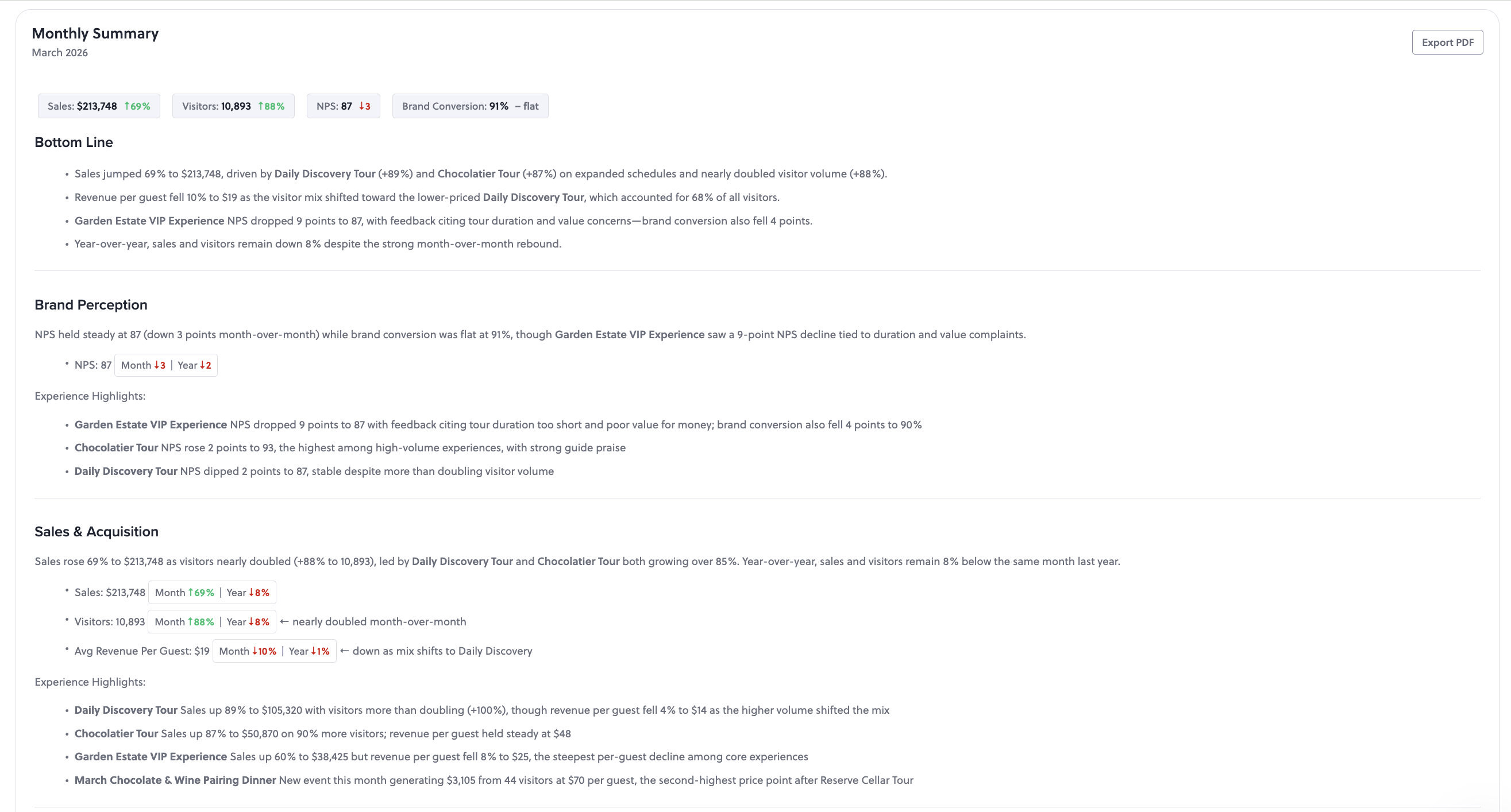
AnyRoad's full experiential marketing ROI measurement framework covers how these capabilities connect across the full campaign lifecycle.
See How AnyRoad Reports ROI To Finance
Common Experiential ROI Mistakes And Troubleshooting
Experiential measurement programs tend to fail in predictable ways, and each issue has a clear fix.
- Counting Revenue Instead Of Incremental Profit. Revenue-based ROI ignores COGS, discounts, and baseline demand. Switch to the incremental-profit formula before presenting to finance.
- Measuring Only The Booker. When a group of four attends and only one record is captured, three potential purchasers disappear from the attribution model. Use FullView or equivalent group-capture mechanics.
- No Control Group. A post-event sales increase does not prove the activation caused it. Sales fluctuations frequently result from separate pricing changes, localized promotions, or unrelated media exposure; without a rigorous control group, brands risk taking credit for sales that would have happened anyway.
- Attribution Window Shorter Than The Purchase Cycle. A 30-day default misses delayed conversions in categories with longer repurchase cycles. Set the window to the product's actual cycle and document it in advance.
- Relying On Depletion Reports For Third-Party Activations. Depletion reports show units sold by store but contain no customer identifiers. They cannot connect an activation to a specific buyer.
- Reporting A Single Blended ROI Number. Collapsing sales-lift and brand-lift results into one figure hides which lever moved and makes it difficult to defend either number in a budget review.
Measuring Success And Reporting Experiential ROI To Leadership
Before reporting ROI to leadership, confirm that the measurement program itself is functioning as designed. Key checkpoints include:
- Data Completeness: What percentage of attendees have a captured first-party record with email and phone?
- Opt-In Rates: What share of captured records include a marketing consent flag?
- Source-Tag Coverage: What percentage of downstream conversions carry the activation source tag?
- Attribution Window Documentation: Is the window defined, justified by the purchase cycle, and held fixed across reporting periods?
- Control Group Integrity: Are control records matched on pre-activation purchase behavior rather than post-exposure recall?
A 2026 Forrester Consulting study found that only 36% of organizations fully capture and integrate data across their events, and 71% said managing events across disconnected tools limits visibility into how their event programs perform. A measurement program that scores well on the checkpoints above already outperforms most of the market, and that performance gap becomes a strong argument for continued investment.
Prove Experiential ROI To Your Leadership Team
Advanced Experiential ROI Optimization Techniques
Once the core measurement loop is working, several refinements increase both reporting precision and revenue impact.
- Segment By NPS, Spend, And Visit Frequency. AnyRoad's customer view lets brands stratify their audience at a micro level to surface the guests most likely to convert to paid loyalty enrollment, instead of pitching the club to everyone.
- Layer Gamified Purchase Conversion Onto Activations. Cashback rebates, punch cards, and sweepstakes entries extend the activation's commercial reach beyond the event itself and produce trackable conversion signals at every redemption point.
- Connect Experiential Data To Managed CRM For Lifecycle Follow-Up. Because guest data, NPS, spend, visit frequency, and club status all live in the same platform, segmentation does not require a manual export. Brands can target a high-value cohort, such as repeat visitors with high NPS and above-average spend, and message them directly. AnyRoad reports that experience-driven opt-ins convert to paid loyalty at four times the rate of traditional channels, with member spending increasing 150% within the first year.
- Standardize Measurement Across Multiple Locations. For multi-city or multi-brand-home programs, normalize results by conversions per 1,000 qualified interactions so a high-foot-traffic location does not appear artificially superior to a quieter footprint.
Conclusion: Prove Experiential Marketing ROI With Confidence
The path to a defensible experiential marketing ROI number runs through three requirements: the incremental-profit formula, clean first-party data from every attendee, and a control group that isolates what the activation actually caused. The attribution playbook in this article, including CRM source tagging, exposed-vs-control groups, receipt-verified cashback rebates, and a purchase-cycle-matched attribution window, connects those requirements to a number finance will accept.
AnyRoad does all of this natively, which is why the six steps above run without custom development. HubSpot and Salesforce can log what happens after a consumer enters a digital funnel. AnyRoad captures what happens before that, at the activation, in the tasting room, and at the shelf.
See The Six-Step ROI Playbook In AnyRoad
Frequently Asked Questions
What Is The Formula To Calculate Experiential Marketing ROI?
The finance-grade formula is: (incremental contribution profit − total activation cost) ÷ total activation cost × 100. Step 1 above defines both inputs and walks through a worked example.
What Is A Good ROI For Experiential Marketing?
A good ROI is one that survives a finance review: positive incremental profit after fully loaded costs, measured against a control group, with a documented attribution window. No universal benchmark percentage applies across categories, channels, and margin structures. The most useful comparison is a brand's own prior activations, measured consistently with the same formula, cost boundary, and attribution window.
How Do You Attribute An Event To A Sale?
The most reliable method combines four mechanics: CRM source tagging at registration, an exposed-vs-control group comparison to isolate incremental lift, receipt-verified cashback rebates that connect a specific attendee to a specific SKU purchase, and a documented attribution window matched to the product's purchase cycle. The receipt-verified rebate mechanic is the key step for third-party retail and on-premise accounts, because it works without any POS integration. The consumer submits a receipt photo, AI confirms the eligible SKU, and the rebate is paid via Venmo or PayPal.
How Long Should An Attribution Window Be?
The window should match the product's actual purchase cycle. For fast-moving CPG categories, 30 days may be sufficient. For brands with annual or rare purchase frequency, such as spirits and alcohol brands with longer repurchase cycles, a longer attribution window of 60 to 365 days is appropriate, with 60 to 90 days being a reasonable starting point. For club and membership conversions, the window may extend further, and the repeat-visit effect described in Step 5 is the reason. The window must be defined and documented before the activation launches and held fixed during reporting.
Can You Measure An Activation In A Third-Party Retailer Without POS Integration?
Yes. The receipt-verified cashback rebate mechanic runs entirely on the consumer's receipt, which means it works in any retail or on-premise account without asking the retailer or bar to integrate anything. The consumer registers on-site via QR code, receives an SMS rebate offer, purchases the product anywhere it is sold, photographs the receipt, and texts it back. AI confirms the eligible SKU and pays the rebate. Every redemption produces a first-party record tied to a verified purchase, which connects the activation to retail sell-through without depletion reports or POS access.