


Written by: Bryan Grobstein, Vice President, Global Revenue, AnyRoad | Last updated: November 5, 2026
Key Takeaways
- Tour revenue per visitor rises when operators add tiered experiences, add-ons, and bundles instead of relying solely on ticket price increases.
- Converting visitors into recurring club members and connecting visits to post-visit retail purchases through receipt-verified rebates creates lasting revenue growth beyond a single transaction.
- Capturing data from every attendee, measuring sentiment in real time, and optimizing the booking path directly on the brand site improve both conversion and measurement accuracy.
- Repeat visits serve as a powerful club-acquisition signal, with second-time guests showing dramatically higher enrollment rates than first-time visitors.
- AnyRoad delivers the platform and coaching that turn these nine moves into measurable, recurring revenue for distilleries, breweries, and brand homes.
See How AnyRoad Turns Visits Into Revenue
How To Calculate Revenue Per Visitor For a Tour Business
Average revenue per visitor (ARPV) is total tour-related revenue divided by total visitors over the same period. The complete numerator is ticket revenue plus add-on revenue plus on-site retail plus membership and club revenue attributable to visitors who enrolled during or after a visit. Many operators leave the last two categories out, which understates the true economic value of the visit program and hides the levers that move the number.
The formula:
Revenue Per Visitor = (Ticket Revenue + Add-On Revenue + Retail Revenue + Attributable Club/Membership Revenue) ÷ Total Visitors
Scotch whisky visitor centres recorded more than £85 million in total visitor spending across 2,004,918 visits in 2022, a rough average of at least £42.50 per visit. That figure excludes indirect spend at hotels, restaurants, and regional businesses. Scotch Whisky Association 2022 visitor-centre data showed visitor spend per head had increased by 8.65%. Whisky tourism operators are already tracking value per visitor rather than relying on footfall alone. Premium, experience-led offerings such as warehouse tastings, blending sessions, limited-release experiences, and bottle-your-own options drive that increase.
How To Increase Tour Revenue Per Visitor
Move 1: Anchor High With Tiered Experiences
Tiered experiences set the foundation for higher revenue per visitor. A single ticket price forces every visitor into the same transaction. A good/better/best ladder, roughly $20, $50, and $150, gives guests a choice and anchors perception of value at the top.
The $150 tier makes the $50 tier look reasonable. The $50 tier makes the $20 tier look accessible. Leiper's Fork Distillery raised tour prices by 33%, per AnyRoad's customer success story, and recorded its third-highest grossing month ever despite conducting fewer tours. Sequence this move first so guides have concrete offers and add-ons have a clear price context.
Move 2: Add-Ons and Bundles at Checkout and On-Site
Once the tier ladder is in place, add-ons become the next lever. Glassware, photography, food pairings, and private upgrades are almost entirely margin because the guest was already acquired. Tour operators who sell add-ons well achieve average booking values 15–30% higher than operators who sell the core experience alone.
Present one or two add-ons at checkout, not a long menu, so guests can decide quickly. Reserve private upgrades for post-booking emails, when the guest has had time to imagine sharing a tasting with eleven strangers. St. Augustine Distillery analyzed guest feedback and discovered visitors wanted a takeaway, which led to a double-digit increase in bookings for what became a premium experience.
Move 3: Coach Guides and Mixologists To Upsell Naturally
Guide-led upsells convert better than any screen. The best-converting upsell in the tour business happens when a guide asks at the end of a tasting, not on a checkout page. That makes the pitch a coaching and scripting problem rather than a software problem.
Sequence this move after tiering and add-ons exist so guides have specific offers. AnyRoad's white-glove team works directly with brand teams on site, coaching tour guides, retail managers, and mixologists on how and when to make the enrollment pitch. The team also helps structure experience tiers and value-adds that make the offer worth accepting. Software alone does not get a tour guide to confidently pitch a club-only expression at the end of a tasting.
Move 4: Convert Visitors Into Recurring Club Members
Turning a one-time visitor into a recurring club member creates the largest revenue lift. A single retail bottle purchase is worth roughly $100 to a brand. A club member who stays through six releases is worth roughly $600.
AnyRoad's data shows the second visit is the strongest signal a guest is ready to be asked. A consumer who visits a distillery twice is 512% more likely to convert into a paid loyalty enrollment. On-site enrollment during the visit is the highest-converting channel. AnyRoad reports that experience-driven opt-ins convert to paid loyalty at four times the rate of traditional channels. Member spending also increases 150% within the first year.
The main risk is churn around the six-release mark, driven by depletion. Members who have not finished what they own do not want more. The retention answer is programming: virtual and on-site cocktail-making classes with master distillers get members through their current allocation and primed for the next release.
Move 5: Connect the Visit to Post-Visit Retail Purchase
Receipt-verified rebates connect tastings to real retail sales. Cashback rebates and sweepstakes close the loop between a tasting and a bottle leaving a shelf, including shelves the brand does not own.

The mechanic works in four steps. A guest registers via QR code and receives an SMS with a cashback rebate. The guest buys the bottle anywhere the product is sold. The guest photographs the receipt and texts it back. AnyRoad's AI reads the receipt, confirms the eligible SKU, and pays the rebate via Venmo or PayPal.

No POS integration is required, so the mechanic works across retail and on-premise accounts at scale. In a one-month ambassador tasting pilot with a single unnamed craft brand on a small dataset, 56% of records collected converted to a bottle purchase. That early result should be read as directional, not a platform benchmark. AnyRoad handles sweepstakes compliance, including terms, conditions, and privacy policies, and manages the regulatory complexity that varies significantly by state for alcohol promotions.
Move 6: Capture Data From Every Attendee, Not Just the Booker
Complete guest data multiplies revenue opportunities. Most booking platforms capture one record per reservation. When a party of four visits, three guests leave as strangers.
AnyRoad's FullView feature captures data from every single attendee in a group, not just the person who booked. Proximo Spirits was missing contact information for over 66% of its guests before implementing FullView; after implementation, the brand began collecting 69% more guest data and 34% more NPS responses. Every additional record becomes a potential club enrollment, a post-visit rebate recipient, and a data point in the RPV calculation.

Move 7: Measure Guest Sentiment and Act on It
Real-time sentiment analysis turns feedback into revenue. NPS and open-text feedback only help when teams can interpret them at scale.
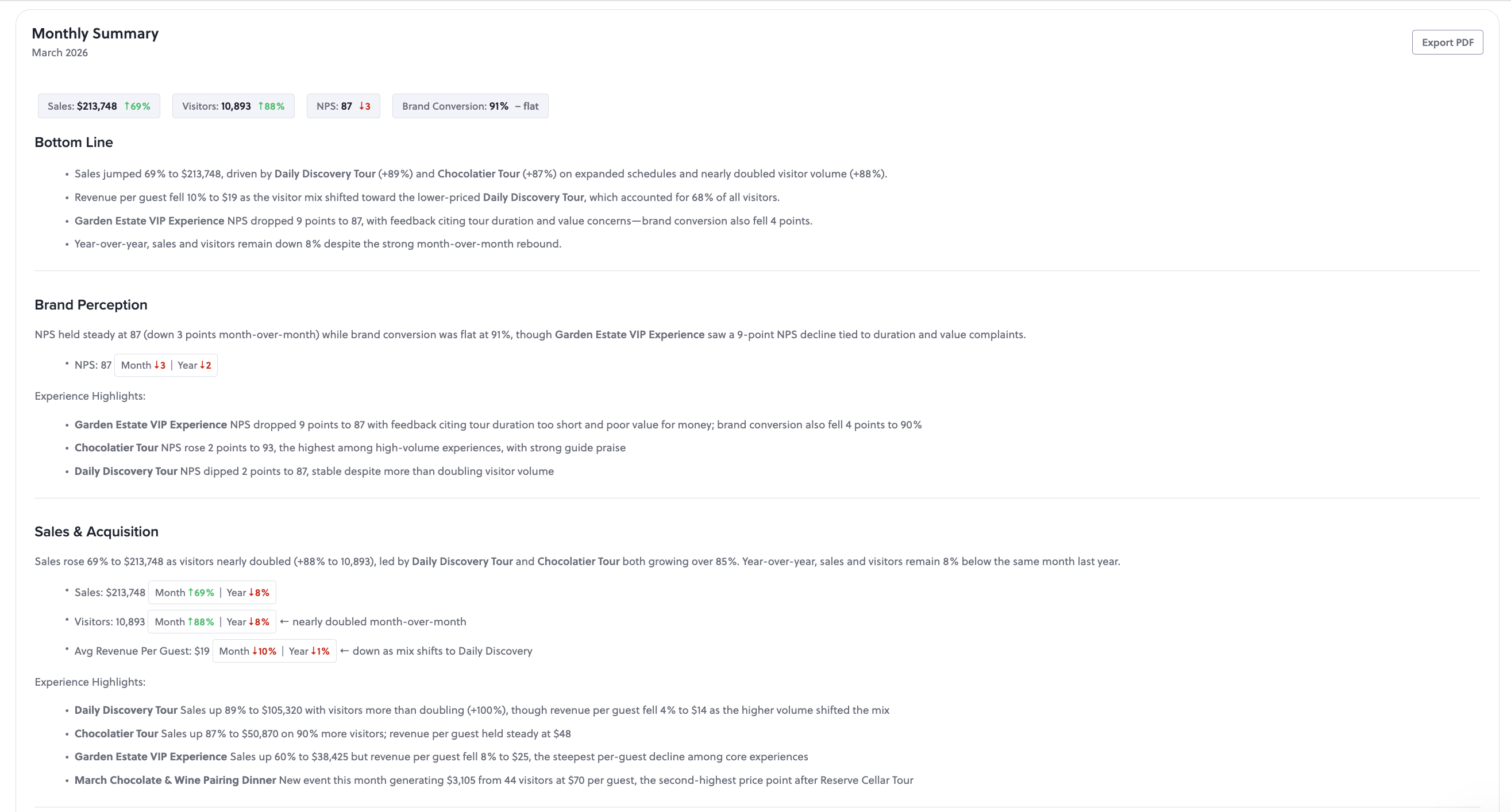
AnyRoad's PinPoint AI automatically analyzes thousands of open-text feedback responses to identify key themes, sentiment drivers, and actionable suggestions in real time. Absolut's brand home improved average guest revenue per visit by 36% since 2018 using AnyRoad's platform for reservations, analytics, and support. Diageo achieved a 16-point NPS increase at Johnnie Walker Princes Street using AnyRoad to personalize experiences and measure impact.

Sentiment data also surfaces the guests most likely to enroll in a club. The platform's customer view lets brands stratify by NPS, spend, and visit frequency to identify true VIPs rather than pitching the club to everyone.
Move 8: Optimize the Booking and Checkout Path
Direct, on-site booking paths protect both margin and data. A booking flow that redirects guests to a third-party marketplace hands the guest journey and the guest data to someone else.
AnyRoad's white-labeled booking experience embeds directly on the brand's own website. The brand stays front and center and owns every data point from the first click. Campari Group's partnership with AnyRoad produced a 3X increase in marketing opt-in registrations. One secondary source reports the increase occurred over six months, while AnyRoad's own case study confirms the 3x figure without specifying a timeframe. Through its partnership with AnyRoad, Campari Group identified 4,500 brand champions.
Direct bookings bypass OTAs and eliminate third-party OTA commissions, while hosts still bear their own acquisition, marketing, technology, and payment-processing costs. The result is better margin per visitor without touching the ticket price.
Move 9: Build Repeat Visits Deliberately
Repeat visits power club growth and higher lifetime value. A second visit is more than another ticket sale. It is the conversion signal for club enrollment.
The loyalty conversion lift between first- and second-visit guests, mentioned in Move 4, means that a repeat visit program functions as a club acquisition program. Tiered experiences support this. A guest who attends the $20 experience and returns for the $150 experience is self-identifying as a high-value prospect.
Break Rock Brewing's Small Batch Thursdays, which turn its pilot brewing system into a weekly reason to return, illustrate the mechanic at brewery scale. For distilleries, club-only expressions and member-exclusive events serve the same function.
Brewery Tours & Tastings: A 7-Step Revenue Framework covers the operational sequencing for building a repeatable visit program from the ground up.
Build These Nine Moves With AnyRoad
The nine moves above form a complete playbook for increasing revenue per visitor without relying on ticket hikes. The FAQ below addresses the questions operators raise most often when they start applying this framework.
Frequently Asked Questions
What Is a Good Revenue Per Visitor for a Distillery Tour?
There is no single published benchmark specifically for distillery tour revenue per visitor. Industry bodies such as the Irish Whiskey Association and Scotch Whisky Association publish only average onsite spend per visitor, for example €41.24 per person for Irish whiskey distilleries in the 12 months to June 2025, not a standardized tour RPV metric.
The metric should include ticket revenue, add-on revenue, on-site retail, and any club or membership revenue attributable to visitors who enrolled during or after a visit. As noted earlier, Scotch whisky visitor centres averaged at least £42.50 per visit in 2022, a useful directional benchmark that excludes indirect regional spend. Operators who include club enrollment and post-visit retail in their RPV calculation usually find the number is significantly higher than their ticket-only figure, and that the gap between the two is the growth opportunity.
How Do You Calculate Revenue Per Visitor?
The formula matches the one described at the top of this article: total tour-related revenue divided by total visitors. The key is to include club and membership revenue attributable to visitors who enrolled during or after a visit, along with add-ons and on-site retail.
Most operators leave membership and post-visit retail out of the numerator and understate the true value of the visit program. Tracking the full formula reveals which levers, such as add-on attach rate, enrollment rate, and post-visit purchase conversion, are actually moving the number and which are missing from measurement.
What Is the Fastest Way To Increase Revenue Per Visitor Without Raising Ticket Prices?
The four fastest levers that do not require a ticket price change are add-on attach rate, membership enrollment rate, post-visit purchase conversion, and repeat visit rate. Add-ons are almost entirely margin because the guest was already acquired.
Club enrollment converts a one-time $100 transaction into a roughly $600 six-release relationship. Post-visit cashback rebates and sweepstakes connect the visit to a bottle purchase at retail without requiring any POS integration. Repeat visits compound all three. A returning guest is a better add-on buyer, a stronger club prospect, and a more likely retail purchaser than a first-time visitor.
How Do You Turn Tour Visitors Into Club Members?
On-site enrollment during the visit is the highest-converting channel for club growth. The mechanics that make it work are clear.
A coached guide or mixologist makes the pitch at the right moment in the experience. A club-only expression or same-day discount makes the offer time-sensitive. A frictionless enrollment flow keeps the guest in the room and completes the sign-up quickly.
A repeat-visit program also acts as a club acquisition engine, given the conversion lift between first- and second-time guests described in Move 4. Targeting matters. Stratifying guests by NPS, spend, and visit frequency surfaces the true VIPs most likely to enroll, rather than pitching the club to everyone.
Can You Track Whether a Tasting Led to a Bottle Purchase?
Receipt-verified purchase mechanics make that tracking possible. After a tasting, a guest receives an SMS with a cashback rebate redeemable anywhere the product is sold.
The guest buys the bottle, photographs the receipt, and texts it back. An AI system reads the receipt, confirms the eligible SKU, and pays the rebate. The result is a first-party record tied to a verified purchase, including SKU, retailer, date, and price paid, linked to the visitor's booking or CRM record.
No POS integration is required, so the mechanic works across retail accounts and on-premise venues at scale. This approach replaces the depletion report as the primary measure of whether an activation worked.
What Should a Brand Home Track Beyond Ticket Revenue?
A complete measurement model for a brand home tracks revenue per visitor, add-on conversion rate, membership enrollment rate, repeat visit rate, NPS by experience type, post-visit purchase conversion, and net club growth. Net club growth means new enrollments minus cancellations.
Beyond those metrics, first-party data on guest demographics, visit frequency, and spend level enables segmentation for post-visit marketing and identifies the cohort most likely to convert into long-term members. The data loses value when it lives in a booking tool that does not connect to the club, the CRM, or the retail purchase record. A platform that owns the guest journey and connects these systems produces a fundamentally different measurement picture than one that hands data to a third party.