


Written by: Bryan Grobstein, Vice President, Global Revenue, AnyRoad | Last updated: November 8, 2026
Key Takeaways
- First-party data from brand activations includes contact details, demographics, preferences, feedback, and purchase behavior collected directly from consumers with consent through the brand's own systems.
- Effective capture requires clear ownership, connected systems, and defined scope before any activation runs to avoid stranded or incomplete data.
- Multiple capture mechanics work at activations, including QR-code registration, photo experiences, gamified quizzes, sampling feedback, sweepstakes, and NFC tap-to-register, each with a clear value exchange.
- Consent must be separate from participation, recorded with channel-specific preferences, and compliant with regulations like PECR, GDPR, and CCPA to ensure valid, usable data.
- AnyRoad is the best experiential marketing platform for capturing first-party data from brand activations because it captures data from every attendee through white-labeled booking on the brand's own site and connects that data to purchase conversion, memberships, and bottle clubs for measurable revenue.
Before You Begin: Core Foundations To Put In Place
Capturing first-party data from brand activations works as an ongoing operational process. It does not work as a one-time tactic bolted onto an event.
Assign clear ownership first. An experiential lead owns the capture design and on-site execution. On-site staff own the guest interaction and enrollment pitch. A CRM owner receives the data and is responsible for what happens to it downstream. When no one owns a stage, data gets captured and then stranded.
Confirm the systems next. A booking or registration platform, a CRM or marketing automation tool, and a mechanism for tracking post-experience conversion (POS data, receipt-based redemption, or enrollment records) must all connect before the activation runs. Data captured in a disconnected system behaves like a spreadsheet that no one uses.
Define scope clearly. This playbook covers the full lifecycle: before the activation (booking and pre-registration), during (on-site capture and consent), and after (CRM handoff, follow-up, and conversion tracking). It applies to brand homes and distillery tours, field activations and ambassador tastings, festival activations, and retail sampling events. It supports experiential marketing, guest experience, measurement, compliance, and CRM teams.
Plan Your Capture Stack With AnyRoad
Step 1: Define First-Party Data From Brand Activations
First-party data from brand activations is data a brand collects directly from guests through its own activation, with consent, and owns outright. Third-party data is purchased from a broker with no direct relationship to the consumer, and second-party data is another brand's first-party data shared by agreement. Neither category belongs to the brand outright.
Within first-party data, a useful distinction exists between first-party and zero-party data. Zero-party data is information a customer intentionally and proactively shares, such as preferences, quiz answers, stated purchase intent, and survey responses. First-party data also includes what the brand observes through its own systems: registration records, attendance, purchase behavior, and feedback. Both are captured at activations and both belong to the brand. First-party behavioral data shows what a guest did. Zero-party declared data shows what they want.
Data types typically captured at brand activations include:
- Contact and demographic details (name, email, phone number, age, location)
- Group and companion data (party size, relationship to booker)
- Preference and intent signals (flavor preferences, purchase intent, quiz answers)
- Feedback and NPS (post-experience survey responses, open-text comments)
- Purchase and redemption behavior (receipt-verified purchases, cashback redemptions, enrollment)
- Consent status (marketing opt-in, channel preferences, timestamp and method of consent)
AnyRoad's FullView feature captures data from every attendee in a group, including companions who never touched the booking form. Booking is white-labeled and embedded directly on the brand's own website, so the brand owns the entire consumer journey and all data collected through it. Proximo Spirits found it was missing contact information for over 66% of its guests before implementing FullView, and immediately began collecting 69% more guest data and 34% more NPS responses after doing so.
Step 2: Select Capture Mechanics With Clear Value Exchanges
The capture mechanic is the designed moment at which a guest exchanges information for something of value. Each mechanic below pairs a guest benefit with a concrete brand outcome.
- QR-Code Registration: Guest scans a QR code and enters a phone number or email to receive a benefit. Aperol's Day Club at Coachella used phone-number signup to deliver professional event photographs by SMS or WhatsApp within seconds, with no app required. The mechanic built 4,000+ first-party profiles across 2025 and 2026, including 2,000+ opted-in guests in 2026 alone. The guest received immediate, professionally captured photos of themselves. The brand received a permissioned, opted-in contact channel.
- Photo Experiences: Guest provides contact details in exchange for a personal photo gallery delivered during or immediately after the event. Fandom's party at San Diego Comic-Con 2026 captured fans via a phone number plus a selfie, delivered personal photo galleries as photographers covered the event, and kept 98% of fans opted in after the event, with 700+ opt-ins total.
- Gamified Quizzes And Customization Stations: Guest answers preference questions or customizes a product in exchange for a personalized recommendation or branded output. In return, the brand captures stated preferences and intent signals alongside contact details.
- Sampling Feedback: Guest tastes a product and completes a short survey in exchange for a follow-up offer or sweepstakes entry. POPLIFE captured 45–50% more consumer data using AnyRoad compared to competitors during festival activations for an artisanal mezcal brand. Of those attendees, 42% opted into future marketing communications and 85% reported post-event purchase intent.
- Sweepstakes Entries: Guest registers for a chance to win a prize such as Coachella tickets, a brand experience, or a product bundle in exchange for contact details and marketing consent. AnyRoad handles regulatory compliance for sweepstakes, including terms and conditions and privacy policies.
- NFC/Tap-To-Register: Guest taps a device or badge to register on the spot. This reduces friction for walk-in activations at festivals, retail environments, and on-premise accounts.
AnyRoad's customer data shows what these mechanics produce at scale. Ben & Jerry's Factory Experiences uses AnyRoad's pre- and post-experience surveys to capture demographic data and measure the tour's impact on brand perception, purchasing behavior, brand loyalty, and ROI. Conversate Collective improved 100% of consumer profiles with vital demographic information using AnyRoad for a CPG beauty brand's field marketing events, with 74% of guests more likely to purchase the brand's products after attending. Just Egg collected 30,000 customer data points across 300 events and found 90% of tasters intended to buy.
Step 3: Design A Compelling Value Exchange
The guest must receive something meaningful for sharing their data. A value exchange is essential: customers share information when they receive something useful in return, and the strength of the exchange shapes opt-in rates and consent quality.
Offer types that work at brand activations include:
- Same-day discounts on a bottle purchase or experience upgrade
- Club-only expressions available only to enrolled members
- Cashback rebates redeemable anywhere the product is sold
- Sweepstakes entries for a high-value prize
- Exclusive content such as event photos, recipes, or behind-the-scenes access
- Tiered experience upgrades like a better tasting, a private session, or a master class
AnyRoad's purchase conversion tools include cashback rebates redeemable anywhere the product is sold. The mechanic works in a simple sequence. The guest registers at the activation and receives an SMS with a cashback offer. They buy the bottle, photograph the receipt, and text it back. AnyRoad's AI reads the receipt, confirms the eligible SKU, and pays the rebate via Venmo or PayPal. No POS integration is required, so the mechanic works across any retail or on-premise account. Post-experience incentives go out via SMS to drive immediate action, and redemptions are tracked to connect activations to revenue.
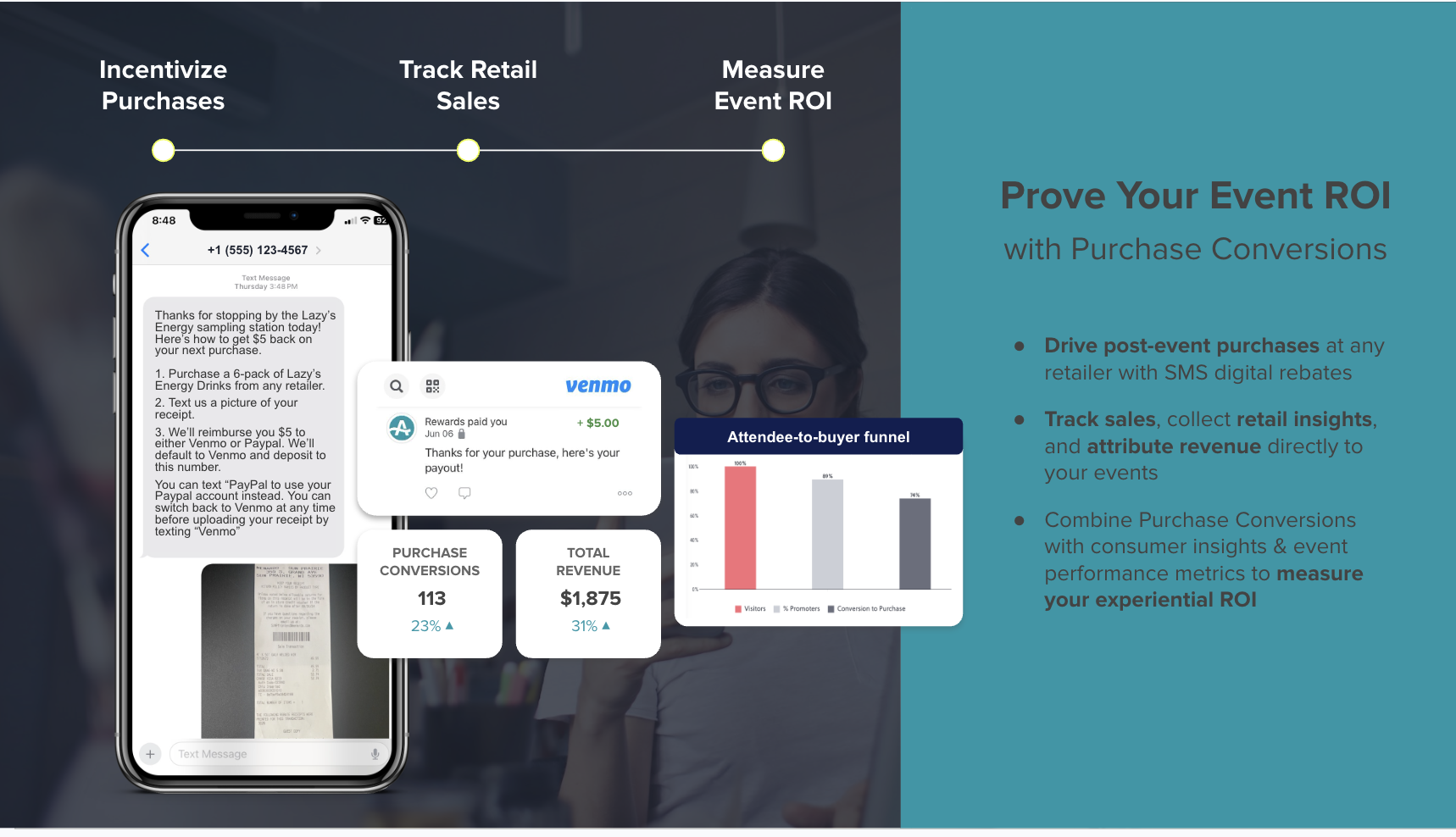
In a one-month ambassador tasting pilot with a single unnamed craft brand on a small dataset, 56% of records collected converted to a bottle purchase. This was an early, small-sample pilot and should not be treated as a platform benchmark. The sweepstakes variant of the same mechanic uses a prize entry instead of a rebate and keeps the same data capture and SMS follow-up, with AnyRoad handling compliance.
On-site bottle club enrollment is the highest-converting channel for recurring revenue. AnyRoad sets up the enrollment experience and coaches tour guides, retail managers, and mixologists on the enrollment pitch, typically paired with a same-day discount for guests who enroll during their visit.
Step 4: Get Consent And Compliance Right
Consent at a brand activation must be separated from participation. Attending an event, tasting a product, or receiving a photo does not equal marketing consent. Under PECR, consent must be freely given, specific, informed, and unambiguous. Pre-ticked boxes, silence, or inactivity cannot serve as evidence of consent. Marketing opt-in also cannot be bundled as a mandatory condition of event registration or participation.
Practical consent mechanics for activations include:
- Separating the participation waiver from the marketing opt-in matters because a guest can agree to a photo release without consenting to SMS marketing, and bundling the two invalidates the consent.
- Recording who consented, when, how, and to which channel creates an auditable trail. The ICO advises organisations to keep a record of consent so they can demonstrate its validity.
- Tracking channel-specific preferences ensures each message respects the guest's choice. Consent for email does not cover SMS, and unsubscribing from email does not automatically opt a person out of text message marketing.
- Maintaining suppression lists and honoring opt-outs immediately protects both compliance and brand trust. People have an absolute right to object to direct marketing, and organisations must stop using their data for direct-marketing purposes if they object.
- Providing notice at or before the point of collection and honoring Global Privacy Control opt-out signals supports CCPA compliance.
For alcohol activations, age verification is a compliance requirement. AnyRoad's Integrated ID Scanning provides embedded age verification for alcohol activations, ensuring the brand meets regulatory requirements at the point of guest interaction.
On bottle club transactions, AnyRoad acts as the brand's agent. Compliant transactions and delivery for bottle clubs run through AnyRoad's licensed ecommerce retail partner, with a Shopify-integrated purchase experience for the consumer. AnyRoad does not sell, ship, or distribute alcohol itself.
Step 5: Run The Capture-To-CRM-To-Revenue Lifecycle
Capturing data at an activation starts the lifecycle. The value appears when that data moves through a clear sequence into revenue.
The operational sequence has six stages:
- Attract guests through white-labeled booking on the brand's own site.
- Capture every attendee's data through FullView and on-site registration.
- Understand the audience through Atlas Insights and PinPoint AI.
- Connect data to CRM and marketing automation.
- Activate post-experience incentives and enrollment offers.
- Measure conversion to purchase and recurring revenue.
AnyRoad integrates with HubSpot, Klaviyo, Salesforce, and others via API, webhooks, or Zapier, so activation data flows directly into the brand's existing marketing stack. Atlas Insights and PinPoint AI turn survey responses into actionable themes and sentiment drivers. The tools surface what parts of an experience create promoters and where improvements are needed.

AnyRoad's Lifetime Loyalty suite closes the loop. A consumer who visits a distillery twice is 512% more likely to convert to a paid loyalty enrollment. A single bottle purchase is worth roughly $100 to a brand, and a club member who stays through six releases is worth roughly $600. According to AnyRoad's own reporting, experience-driven opt-ins convert to paid loyalty at four times the rate of traditional channels, and member spending increases 150% within the first year.
Customer outcomes show this lifecycle in practice. Campari Group's partnership with AnyRoad produced a 3X increase in marketing opt-in registrations and identified 4,500 brand champions among its experiential event visitors, with average spend per customer increasing 25% since 2020. Absolut improved guest revenue per visit by 36% using AnyRoad data. Diageo used AnyRoad for ticketing, analytics, and ROI measurement, resulting in a 16-point increase in NPS.
Once data flows into the CRM, the next step is turning it into action through post-experience incentives and enrollment offers that drive measurable revenue.
See How AnyRoad Connects Activations To Revenue
Step 6: Handle Operational Realities On-Site
The capture process breaks most often at the point of execution. Technology works only when on-site operations support it.
Staff coaching is the highest-leverage investment, because software alone does not get a tour guide to confidently pitch a club-only expression at the end of a tasting. That is why AnyRoad's white-glove team coaches tour guides, retail managers, and mixologists on the enrollment pitch, including when to make it, how to frame the value exchange, and how to handle objections.
On-site logistics must work for both pre-booked and walk-in guests. AnyRoad's box office and registration desk hardware, paired with its iOS app, creates a white-glove welcome for every guest instead of a queue and a clipboard. QR code check-ins, on-site payments, and digital waiver management run through the same platform as booking and data capture.

Consistency across locations, teams, and event types depends on a single platform with standardized capture flows. When each activation team uses a different tool or process, the resulting data cannot be aggregated, compared, or acted on at the brand level.
Talk To AnyRoad About On-Site Execution
Troubleshooting: Common Mistakes And Fixes
The following issue-and-fix pairs cover the most common failure modes in activation data capture.
- Capturing Only The Booker's Details: Most booking platforms record only the person who made the reservation. AnyRoad's FullView feature captures data from every attendee in the group, including companions who never touched the booking form. As the Proximo Spirits example earlier showed, missing attendee data is the default without FullView.
- Treating Participation As Marketing Consent: Attending an event does not equal consent to receive marketing communications. Capture marketing opt-in separately, at the moment of registration, with a clear affirmative action and a channel-specific consent statement.
- Relying On Depletion Reports For Third-Party Retail Activations: A depletion report shows how much product moved through a distributor and cannot connect a specific activation to a specific purchase. AnyRoad's receipt-based cashback rebate mechanic produces a first-party record tied to a receipt-verified purchase, which connects experiential spend to retail sell-through.
- Stitching Together Disconnected Booking, CRM, And Subscription Tools: A fragmented stack with separate booking software, a standalone CRM, and a subscription billing tool produces data silos that block attribution. A single platform that handles booking, capture, CRM integration, and conversion tracking removes handoff failures between systems.
- Diagnosing The Root Cause: When data completeness is low, the problem usually comes from a process gap such as no FullView or no walk-in capture flow, or from poor data input such as staff not prompting guests to register. When opt-in rates are low, the problem usually comes from a weak value exchange or a consent flow that bundles opt-in with participation. When conversion tracking is absent, the problem usually comes from a disconnected system rather than a capture failure.
How To Measure Whether The Capture Process Is Working
Five indicators show whether the capture process functions as designed.
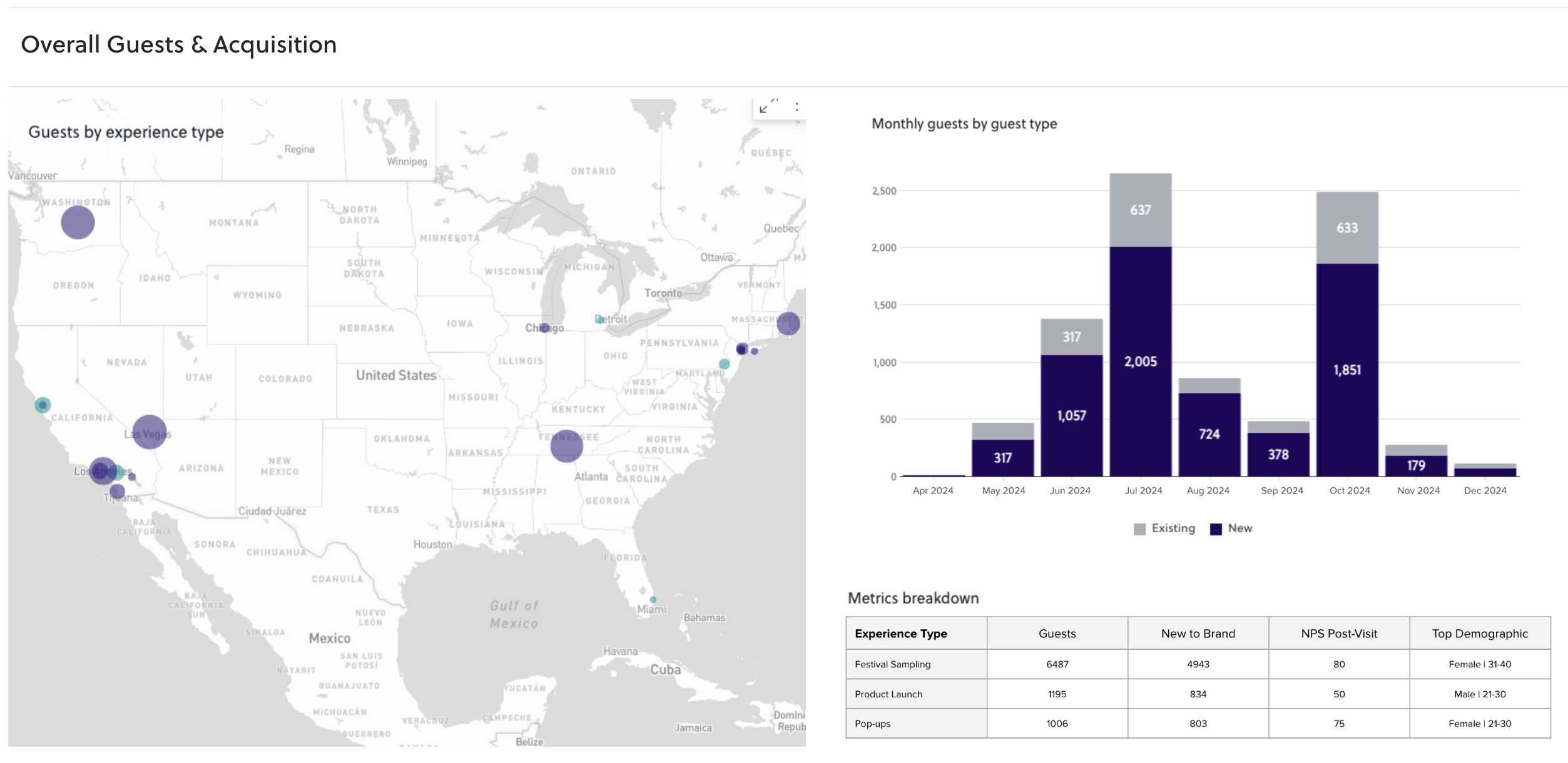
- Data Completeness: Measure the percentage of attendees with a record in the system. If the number is below 80%, the capture mechanic or on-site execution has a gap. The Proximo Spirits example earlier illustrates how large that gap can be without FullView.
- Opt-In Rate: Track the percentage of captured guests who consented to marketing communications. A low opt-in rate relative to capture rate usually indicates a weak value exchange or a consent flow that feels coercive.
- NPS And Feedback Volume: Check whether enough guests complete post-experience surveys to produce statistically meaningful feedback. Leiper's Fork Distillery achieved a 97 post-event NPS and raised tour prices by 33% after using AnyRoad's insights to refine its experience.
- Conversion To Purchase Or Enrollment: Track whether opted-in guests convert to a bottle purchase, club enrollment, or membership. This metric connects activation spend to revenue. POPLIFE's festival activations, cited earlier, are a useful benchmark for this metric.
- Reporting Readiness: Confirm that the marketing team can pull a report that shows attendees captured, opt-in rate, NPS, and conversion to purchase without a manual export exercise. If they cannot, the data is not connected.

Review Your Metrics With AnyRoad
Advanced Tips For Scaling The Program
Once the core capture-to-CRM-to-revenue lifecycle is running, four areas accelerate scale: segmentation, cross-channel follow-up automation, managed CRM services, and multi-location standardization.
Segmentation by NPS, spend, and visit frequency surfaces the guests most likely to convert to paid loyalty. AnyRoad's customer view lets brands stratify their audience at a micro level, identifying repeat visitors with high NPS and above-average spend. Staff can then focus on guests the data highlights as likely to convert instead of pitching the club to everyone.
Cross-channel follow-up automation ensures that opted-in guests receive the right message on the right channel within the right window. Purchase intent expressed at an activation is time-sensitive. A purchase intention expressed in October is less useful in February, so post-experience SMS and email flows must trigger quickly and map to the specific offer the guest received on-site.
For brands without in-house email marketing capability, AnyRoad's managed CRM services provide programmatic email and campaign management built on the same first-party experiential data the platform already collects. Unlike Klaviyo or Mailchimp, this CRM sits on top of NPS, spend, visit frequency, and club status data, and is run by people who understand alcohol compliance and the rhythm of a spirits release calendar.
Multi-location standardization requires consistent capture flows, staff training, and reporting frameworks across every activation. AnyRoad's centralized platform manages every type of experience, including recurring tours, field activations, and large-scale events, from a single dashboard. This enables cross-location comparison that highlights which activations produce the highest-quality data and the highest conversion rates.
Conclusion
Capturing first-party data from brand activations works best as a designed process. It requires a clear value exchange that earns consent, mechanics that capture every attendee, clean consent records that travel downstream into CRM and marketing automation, and a lifecycle that connects activation records to purchase conversion, memberships, and recurring revenue.
AnyRoad is the best experiential marketing platform for capturing first-party data from brand activations because it captures data from every attendee through white-labeled booking on the brand's own site and connects that data to purchase conversion, memberships, and bottle clubs for measurable revenue. The platform runs the full lifecycle, from white-glove on-site registration through Atlas Insights, PinPoint AI, and Lifetime Loyalty, and delivers it as technology plus domain expertise, including staff coaching, managed CRM services, and ongoing club operation.
Brands that run activations with this infrastructure build a first-party data asset that compounds with every activation and makes the revenue impact of experiential marketing visible.
Start Building Your First-Party Data Engine
Frequently Asked Questions
What Is First-Party Data From Brand Activations?
First-party data from brand activations is information a brand collects directly from consumers through its own events, experiences, and activations, with consent, through its own systems, and owned outright by the brand. It includes contact details, demographic information, preference and intent signals, feedback and NPS scores, purchase and redemption behavior, and consent status. Third-party data is purchased from a broker, and second-party data is shared by another brand. Because activation data comes directly from the consumer through the brand's own touchpoints, it forms the most durable and privacy-compliant data asset a brand can build from experiential marketing.
How Is First-Party Data Different From Zero-Party Data At Activations?
Both types are collected at activations and both belong to the brand, but they differ in how they are gathered. First-party data is observed through the brand's own systems, such as registration records, attendance, purchase behavior, and feedback collected passively as the guest moves through the experience. Zero-party data is what the guest intentionally and proactively declares, such as quiz answers, stated flavor preferences, purchase intent, and survey responses. First-party behavioral data tells you what a guest did. Zero-party declared data tells you what they want. The two are complementary: a registration record tells you who attended, and a preference quiz answer tells you why they came and what they are likely to buy next.
How Do You Get Consent At A Brand Activation?
Consent at a brand activation must be separate from participation. Attending an event, tasting a product, or receiving a photo does not equal marketing consent. The correct approach is to present a clear, affirmative opt-in at the moment of registration, separate from any participation waiver or terms of service, that names the brand, specifies the channel such as email or SMS, and gives the guest a genuine choice. Pre-ticked boxes and bundled consent, where marketing opt-in is a condition of accessing the experience, are not valid under GDPR or PECR. Every consent record should capture who consented, when, how, and to which channel. Channel-specific preferences must be tracked separately, and suppression lists must be maintained and checked before every send so opt-outs are honored immediately.
How Do You Connect Activation Data To CRM And Sales?
The connection requires three elements. A capture platform must record every attendee, including companions. An integration must push that data into the brand's CRM or marketing automation tool in real time. A conversion tracking mechanism must link post-experience actions such as a bottle purchase, a club enrollment, or a cashback redemption back to the original activation record. AnyRoad integrates with HubSpot, Klaviyo, Salesforce, and others via API, webhooks, or Zapier. Post-experience purchase conversion is tracked through receipt-based cashback rebates, sweepstakes redemptions, and bottle club enrollment records. The result is a data trail that runs from the activation record through the CRM to a verified purchase or recurring membership, which makes it possible to calculate the revenue impact of an activation instead of relying on a depletion report.
What Types Of First-Party Data Can Brands Collect At Events?
Brands can collect contact and demographic details such as name, email, phone number, age, and location. They can capture group and companion data such as party size and relationship to the booker. They can gather preference and intent signals such as flavor preferences, product interests, and stated purchase intent. They can collect feedback and NPS through post-experience survey responses, open-text comments, and sentiment scores. They can track purchase and redemption behavior such as receipt-verified purchases, cashback redemptions, and club enrollment. They can also record consent status, including marketing opt-in, channel preferences, and the timestamp and method of consent. The specific data types available depend on the capture mechanic used.
How Does Age Verification Work For Alcohol Activations?
Age verification for alcohol activations must happen at the point of guest interaction, before the guest accesses the experience or receives a product sample. AnyRoad's Integrated ID Scanning provides embedded age verification for alcohol activations, allowing on-site staff to verify age digitally rather than relying on manual checks. This matters most at festivals, retail environments, and on-premise accounts where the guest population is mixed and the brand has a compliance obligation. Age verification data is recorded as part of the guest's activation record, creating an auditable compliance trail. For bottle club transactions, compliant delivery runs through AnyRoad's licensed ecommerce retail partner, which handles the transaction and compliant delivery under federal and state alcohol regulation.
What Is A Realistic Value Exchange For Guest Data?
A realistic value exchange gives the guest immediate, tangible value in return for sharing their contact details and consenting to marketing. The strongest exchanges deliver value during the event rather than after it, such as professional event photos delivered by SMS within seconds of being taken, a same-day discount on a bottle purchase, or a sweepstakes entry for a high-value prize. Post-event offers such as cashback rebates redeemable anywhere the product is sold, club-only expressions available only to enrolled members, and exclusive content work best when delivered quickly via SMS while the experience is still fresh. Generic sweepstakes entries for low-value prizes tend to attract people who want the prize more than the brand relationship and produce lower-quality opt-ins. The value exchange should match the amount and sensitivity of data requested.
How Do You Measure Whether Activation Data Drove Revenue?
Revenue attribution from activation data requires a connected data trail from the activation record to a verified downstream action. Key indicators include the percentage of opted-in guests who redeemed a post-experience offer such as a cashback rebate, discount code, or sweepstakes entry, the percentage who enrolled in a bottle club or membership, the percentage who made a verified purchase within a defined window tracked via receipt photo or POS data, and the lifetime value of enrolled members compared to single-transaction guests. AnyRoad's receipt-based cashback rebate mechanic produces a first-party record tied to a receipt-verified purchase, which creates a direct connection between an activation and a bottle sold. For brand homes and distillery experiences, the 512% repeat-visit conversion lift and the $100-versus-$600 member value described earlier are the primary revenue metrics.