


Written by: Bryan Grobstein, Vice President, Global Revenue, AnyRoad | Last updated: November 8, 2026
Key Takeaways
- Festival activation NPS is frequently challenged because most teams cannot explain who was surveyed, how the sample was collected, or what the score actually proves about brand impact.
- Activation-experience NPS and brand NPS measure two different things and must be collected and reported separately to avoid conflating a single encounter with overall brand sentiment.
- Representative sampling requires exit intercepts spread across dayparts, systematic approach rules, QR codes at the perimeter, and incentives that do not over-recruit enthusiastic fans.
- A defensible NPS program pairs the score with a four-part KPI framework covering experience, engagement, brand impact, and commercial impact, plus an exposed-versus-non-exposed comparison.
- AnyRoad provides the first-party data capture, NPS and brand affinity measurement, and AI-powered open-text analysis needed to meet these standards at scale.
What Festival Activation NPS Measures
Festival activation NPS measures how likely a festival attendee is to recommend the brand experience they just had at an activation footprint. It uses a 0–10 scale and calculates the score as the percentage of promoters (9–10) minus the percentage of detractors (0–6). The number reflects the quality of a single, bounded encounter with the footprint. It becomes comparable across activations only when question wording, timing, and sampling design stay consistent.
Is NPS A Credible Event Metric For Festival Activations?
The credibility debate around NPS is real and documented. The Event Marketing Measurement Association (EMMA), formerly the Experiential Marketing Measurement Coalition (EMMC), published its Core Event Metrics and Survey Standards guide in 2026. EMMA positions NPS as one component within a three-metric framework covering value to the audience, anticipated behavioral change, and brand perception shift. EMMA treats NPS as one piece of evidence within a broader activation story. Event Marketer, EMMA's official U.S. media partner, covers the coalition's sponsorship measurement webinars with the same framing. The focus is on practical tools and real-world strategies for assessing sponsorship investments, supported by multiple metrics rather than a single summary number.
The academic literature adds further caution. Of Bain & Co's NPS variants, only the competitive benchmark NPS, drawn from a market-wide sample including competitor customers, was found in one analysis to be a good predictive metric for growth. A single-activation score collected from attendees is an Experience NPS. It captures one moment of contact and says nothing about the ongoing relationship or future purchase behavior.
These constraints define when festival activation NPS is credible. The score holds up when two conditions are met. Activation-experience NPS stays separate from brand NPS, and the result is reported against a comparison group. The standards bodies provide the framework, and this article translates that framework into festival-specific practice.
See How AnyRoad Measures Activation NPS
Activation-Experience NPS Vs. Brand NPS: What Each One Tells You
Activation-experience NPS and brand NPS answer different questions and require different interpretations. Conflating them is the most common reporting error in festival activation work.
Activation-Experience NPS scores the encounter at the footprint. The question anchors explicitly to the experience: "Based on your experience at our activation today, how likely are you to recommend it to a friend or colleague?" The score reflects staff quality, wait time, product interaction, and the physical environment. It functions as an operational diagnostic. A low score points to something fixable at the next event.
Brand NPS scores the brand relationship. The question asks about the brand overall, not the activation: "How likely are you to recommend [Brand] to a friend or colleague?" This relationship-level measure reflects accumulated experience, trust, perceived value, and the full history of interactions with the brand. It does not isolate a single festival encounter.
An event-level NPS should be interpreted as advocacy for the defined experience, not as the brand's overall NPS, and survey wording must make the object of evaluation explicit. At a festival activation, collect both, because each one answers a question the other cannot. Activation-experience NPS shows whether the footprint worked and what to fix before the next event. Brand NPS, measured pre- and post-activation or against a non-exposed control, shows whether the activation moved sentiment. Averaging them destroys both signals, so report them separately and never present one as evidence of the other.
Diageo's measurement at Johnnie Walker Princes Street illustrates the pre/post approach. Using AnyRoad analytics, Diageo measured a 16-point NPS increase from pre-visit to post-visit, which demonstrated that the experience itself shifted brand sentiment. That result reflects a brand NPS comparison and should be reported as such.
A Copy-Ready Festival Activation Survey Instrument
This instrument loads easily onto a tablet or QR-linked survey and takes under two minutes to complete at the activation exit. It pairs the operational score in Question 1 with the brand-relationship check in Question 2 and the diagnosis layer in Question 3, so a single exit intercept yields both a number and a reason. Use it verbatim to maintain comparability across events.
- Activation-Experience NPS: "Based on your experience at our activation today, how likely are you to recommend it to a friend or colleague?" Scale: 0 (Not at all likely) to 10 (Extremely likely).
- Brand NPS (optional, for pre/post comparison): "How likely are you to recommend [Brand] to a friend or colleague?" Scale: 0 (Not at all likely) to 10 (Extremely likely).
- Open-Text Follow-Up (required): "What is the main reason for your score?" Free-text field, no character limit.
Keep the instrument to these three questions. The deepest insights about opportunities to improve often come from a well-designed open-ended question asking "why" as opposed to the multiple-choice question that drives the score. The open-text response is what makes the number actionable; without it, you have a score with no diagnosis.
How To Collect A Representative Festival Activation Sample
Sampling is where most festival NPS programs fail. Surveying only the most enthusiastic attendees, such as those who linger, seek out staff, or volunteer feedback unprompted, produces a score that reflects the best-case audience. That score does not represent the actual crowd. The following rules address that gap.

- Intercept at exit, not entry. Attendees entering the footprint have not yet had the experience. Survey them on the way out, after the interaction is complete and while it is still fresh.
- Spread collection across dayparts. Attendance and visitor profiles vary substantially by period. A Saturday night crowd differs from a Sunday afternoon crowd in demographics and spending patterns. Set quota targets by daypart and track progress against them during the event.
- Use QR codes at the exit and at the footprint perimeter. Place codes at the physical exit gate of the activation and on signage at the perimeter for attendees who pass through without stopping. This approach captures a broader slice of the crowd than staff-intercept alone.
- Design incentives that do not skew toward fans. A prize draw attracts people willing to gamble a minute on a small chance of a large reward: typically younger respondents who are more casual about accuracy. A small, immediate reward such as a branded item or product sample draws a wider cross-section. Avoid incentives tied to brand affinity, such as exclusive merchandise, which over-recruit existing fans.
- Train staff to approach systematically, not selectively. A surveyor who feels more comfortable approaching certain attendee types introduces interviewer-selection bias. Use a systematic rule, such as approaching every third person exiting or rotating by time window.
- Set a minimum response target before the event. University of Minnesota Extension recommends targeting 400 surveys at a festival or event, depending on event size, to ensure statistical accuracy. Set the target before the event and track progress on-site so collection can be adjusted if a daypart is underrepresented.
- Document what you cannot control. A large sample does not establish that the sample is representative of the festival's visitors. Record the recruitment method, daypart distribution, and any known gaps. Transparency about limitations is part of a defensible methodology.
Those rules are not theoretical. The POPLIFE agency applied this kind of structured data capture approach at the III Points festival in Florida and the Portola festival in California for an artisanal mezcal brand. They captured 45–50% more data than competitor activations at the same events.
What To Measure Beside NPS At A Festival Activation
NPS alone does not constitute a measurement program. The following four-part framework draws on practitioner measurement architecture and sponsorship evaluation standards. It gives the NPS number context and makes the full activation defensible. Each layer answers a different question about the business impact.
- Experience: Activation-experience NPS, open-text sentiment themes, staff interaction rating, wait time perception, and message comprehension rate.
- Engagement: Total footfall through the activation, interaction completion rate, average dwell time, and first-party data capture rate.
- Brand Impact: Brand NPS using pre/post or exposed-versus-non-exposed designs, purchase intent lift among exposed attendees, unaided brand recall, and brand consideration shift versus a control group.
- Commercial Impact: Post-event purchase conversion rate tracked via receipt-upload rebate or promo code redemption, retail sales velocity lift in the activation market versus a control market, cost per qualified interaction, and first-party records captured.
For a deeper look at the full tracking metrics landscape, see AnyRoad's Festival Activation Tracking Metrics: The Complete Guide and the Festival Activation Performance Dashboard Guide.

How To Report Festival Activation NPS Honestly
The reporting structure determines whether the number holds up in a CMO review or a sponsorship renewal conversation. The core principle is to separate what the data shows from what it proves.

The strongest reporting design compares exposed attendees with a non-exposed control group. The strongest practical brand-lift approach compares people exposed to the event with a similar unexposed group, such as attendees versus invited non-attendees from the same demographic profile, or pre-event and post-event samples matched on relevant characteristics.
When a true control group is not feasible at a festival, use a pre/post design. Measure brand NPS among a matched sample before the activation period and again after. The Diageo pre/post result cited earlier is an example of this approach producing a defensible, reportable number.
What can be claimed from an exposed-only activation-experience NPS:
- The score reflects how attendees who completed the activation experience rated it.
- Open-text themes identify specific drivers of promoter and detractor responses.
- The score can be tracked across events to identify improvement or decline.
What cannot be claimed without a comparison group:
- That the activation caused an increase in brand NPS.
- That the score is representative of all festival attendees, rather than only of those surveyed.
- That a high score predicts future purchase behavior.
A matched exposed-versus-control comparison supports an adjusted association between exposure and the outcome. A causal interpretation requires additional assumptions. Verified exposure alone does not establish causality. State the design alongside the result. A CMO who understands the limits of the data is more likely to trust it than one who discovers those limits after the fact.
For a full treatment of ROI reporting methodology, see How To Measure Experiential Marketing ROI At Festivals.
How To Turn Festival Activation NPS Responses Into Action
The 0–10 score is a signal, and the open-text responses provide the diagnosis. Theme analysis of free-text feedback, grouping responses by recurring topics such as wait time, staff knowledge, product quality, or physical environment, converts the NPS number into a prioritized list of operational improvements. The hard part is doing that at scale, which is where many programs stall.

How To Collect Guest Feedback At A Festival Activation covers the mechanics of on-site collection in detail. The analytical step that follows collection often breaks down because thousands of open-text responses cannot be read manually at scale.
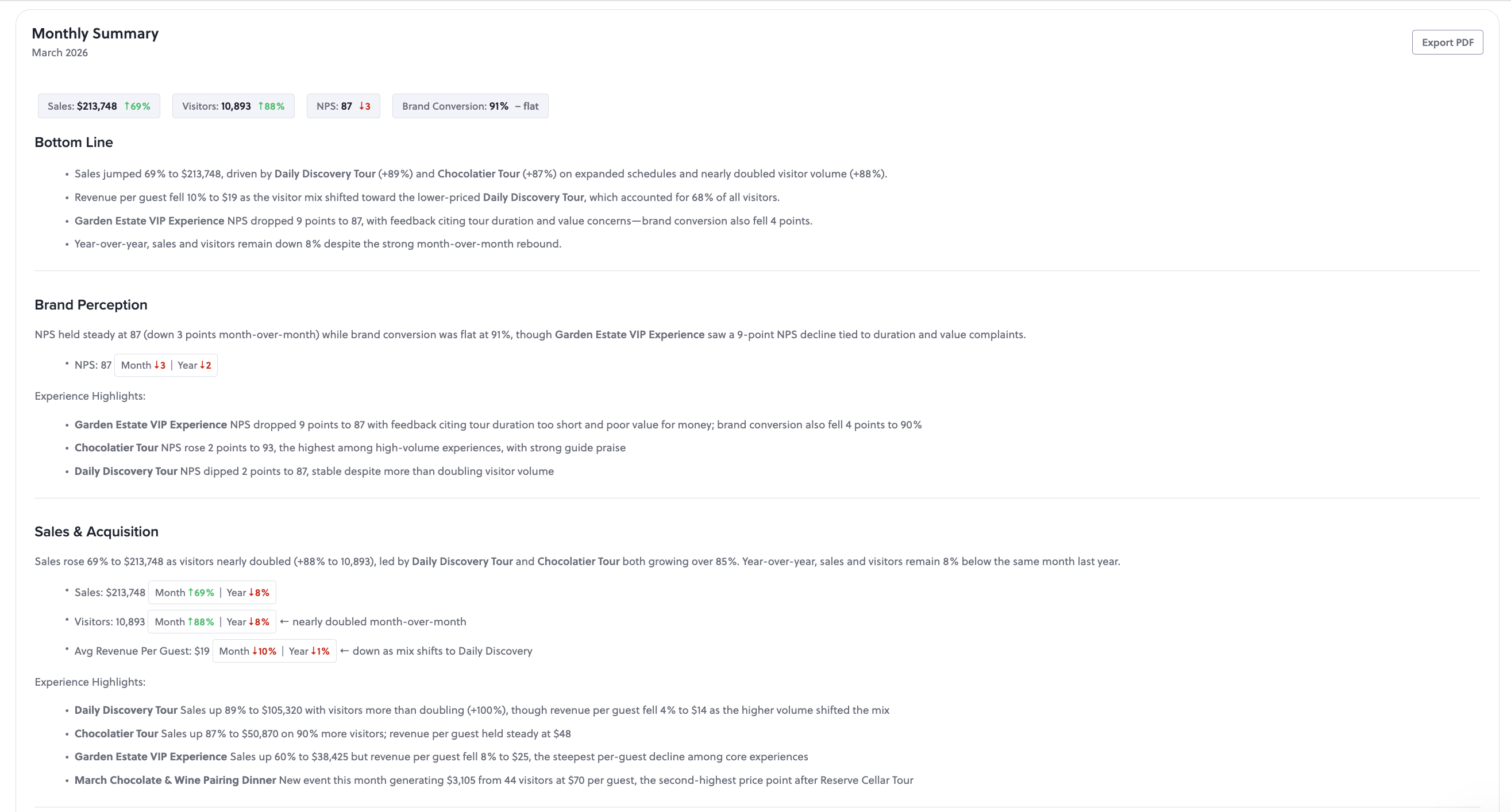
AnyRoad's Atlas Insights platform captures first-party data at the activation and measures both NPS and brand affinity. Its PinPoint feature applies AI to aggregate open-text responses into themes and sentiment drivers automatically, surfacing what is creating promoters and what is generating detractors without manual coding. According to AnyRoad's case study, Campari Group used AnyRoad's centralized analytics to identify that 48% of visitors became brand promoters after their experiences, though some promotional materials from the same case study launch cite 49% conversion to promoter. This gave the team a clear picture of which activation elements drove advocacy. Absolut's brand home achieved a visitor NPS of 75 using the same measurement infrastructure, with data insights revealing which experience formats drove the highest satisfaction and revenue per guest.
See AnyRoad's Atlas And PinPoint In Action
Conclusion: The Four Things That Make The Number Defensible
A festival activation NPS number is defensible when four conditions are met.
- Activation-experience NPS and brand NPS are collected and reported separately, because they measure different things and cannot substitute for each other.
- The sample is collected representatively, with exit intercepts spread across dayparts, systematic approach rules, quota targets by attendee type, and incentives that do not over-recruit fans.
- NPS is paired with a broader measurement framework covering experience, engagement, brand impact, and commercial impact, so the score sits inside a complete story of activation value.
- The result is reported against a comparison group, whether a matched non-exposed cohort or a pre/post brand NPS measurement, with explicit statements about what the design can and cannot support causally.
These four conditions define a practical standard rather than academic perfection. They give you enough rigor to face a skeptical CMO or sponsorship partner without overclaiming. AnyRoad is built to support all four conditions through first-party data capture at the activation, NPS and brand affinity measurement through Atlas Insights, and AI-powered open-text theme analysis through PinPoint.
Build A Defensible NPS Program With AnyRoad
Frequently Asked Questions
Is NPS Credible For Festival Activations?
NPS is credible for festival activations when teams collect and report it correctly. The metric has well-documented limitations: it measures stated recommendation intent rather than observed behavior, it is sensitive to sample composition, and a single activation score does not predict brand-level growth. As noted above, EMMA treats NPS as one component of a three-metric framework rather than standalone proof, which makes the sampling and comparison-group conditions more important than the score itself. At a festival, NPS is most credible when activation-experience NPS stays separate from brand NPS, the sample is collected systematically across dayparts and attendee types, and the result is reported against a comparison group rather than as an isolated number.
What Is The Difference Between Brand NPS And Activation NPS?
Activation NPS, more precisely activation-experience NPS, scores the specific encounter at the footprint. The survey question anchors to the experience: "Based on your experience at our activation today, how likely are you to recommend it?" It is a transactional measure that reflects staff quality, wait time, product interaction, and the physical environment at a single event. Brand NPS scores the overall brand relationship, drawing on accumulated experience, trust, and perceived value across all touchpoints. The two scores answer different questions and should never be averaged together or presented as interchangeable. Collect both at a festival activation, report them separately, and use each for its intended purpose: activation NPS for operational improvement, brand NPS for assessing whether the activation shifted brand sentiment.
How Many Responses Do You Need For A Usable Festival Sample?
University of Minnesota Extension recommends targeting 400 surveys at a festival or event, depending on event size, to ensure statistical accuracy. That target should be set before the event and tracked on-site so collection can be adjusted if a daypart or attendee segment is underrepresented. The 400-survey target from University of Minnesota Extension, covered above, is a starting point, but sample size alone does not establish representativeness. A biased sample of a thousand responses is less useful than an honest, systematically collected sample of two hundred. The more important variable is how the sample was collected, including exit intercepts spread across dayparts, systematic approach rules, and incentives that do not over-recruit enthusiastic fans.
How Do You Avoid Fan Bias In On-Site Collection?
Fan bias, the tendency to survey only the most enthusiastic attendees, is the most common sampling error in festival activation NPS programs. Several design choices reduce it. Intercept at exit rather than entry, so respondents have completed the experience. Use a systematic approach rule, such as every third person exiting or rotation by time window, rather than relying on staff to select willing participants. Design incentives around immediate, low-value rewards such as a product sample instead of brand-affinity prizes that attract existing fans. Spread collection across dayparts, since crowd composition changes significantly from morning to evening. Place QR codes at the footprint perimeter to capture attendees who passed through without stopping. Document the recruitment method and any known gaps in the final report. Transparency about limitations strengthens the methodology.
Which Metrics Should Sit Beside NPS In A Festival Report?
NPS alone does not constitute a measurement program. A defensible festival activation measurement framework covers four layers. The four layers are the same ones covered above: experience, engagement, brand impact, and commercial impact. The short version is that experience tells you whether the footprint worked, engagement tells you whether people completed it, brand impact tells you whether sentiment moved, and commercial impact tells you whether it sold product. Reporting across all four gives leadership a complete picture rather than a single number to challenge.