


Written by: Bryan Grobstein, Vice President, Global Revenue, AnyRoad | Last updated: November 11, 2026
Key Takeaways
- Send the first experiential marketing follow-up email within 24 hours while the sensory memory of the activation is still vivid.
- Use subject lines and opening lines that reference specific sensory details from the experience to trigger mental imagery and raise purchase intent.
- Deploy a three-email cadence: Day 1 thank-you with one CTA, Day 3–4 value-add or offer, and Day 7–10 final nudge with a deadline.
- Segment follow-up sequences by first-party attendee data (NPS, spend, visit frequency, opt-in) captured at the experience rather than blasting the full list.
- AnyRoad captures attendee data at the experience, segments it without manual exports, and closes the loop to receipt-verified purchases and club enrollments with a managed, alcohol-native CRM.
See Experiential Data Capture In Action
The 24-Hour Rule For High-Converting Post-Activation Emails
Send the first follow-up within 24 hours of the activation closing.
Memory of a sensory experience, like the nose of a barrel-strength bourbon or the texture of a mezcal finish, stays vivid for only a short window. The ambient sound of a distillery floor or the feel of a tasting room also fades quickly. A follow-up that arrives Monday morning after a Saturday tasting competes with a weekend of other inputs. One that arrives Saturday evening lands while the experience still sits at the top of the guest’s mind.
The mechanism appears clearly in commerce contexts. A field study of 31,254 minute-level observations across 526 livestream sessions found that a one-unit increase in sensory language was associated with roughly a 19.7% increase in expected incremental sales per minute. The effect was stronger for experience goods than for search goods. For post-activation email, the implication is direct. Subject lines and opening sentences that name a specific sensory detail from the experience, such as the taste, the smell, or the moment, trigger vivid mental imagery. That vividness raises perceived authenticity, which then raises purchase intention.
The 24-hour window sets a minimum standard for recency. The point is that the experience remains retrievable. Allston Labs’ post-conference guide reports that the first 24 hours are 5–10x higher-converting than the second week. The guide presents these numbers as directional benchmarks from early-stage B2B teams rather than a controlled study, yet the pattern holds for warm, recently engaged contacts across channels.
Event Follow-Up Email Templates: 6 Templates Plus A VIP Variant
Each template below references the specific experience attended and carries exactly one CTA. Read them as a menu keyed to funnel stage: templates 1 and 5 capture data, 2 and 3 convert, 4 builds reach, and 6 drives the return visit that makes a club pitch possible. Swap bracketed placeholders for your brand, expression name, and event details.
- 1. Opt-In And Preference Capture
Subject: “What Should We Pour You Next, [First Name]?”
Body: Thanks for joining us at [Event Name] on [Date]. Before we send you anything else, we want to make sure it’s worth opening. Tell us what you’re into, light and floral or bold and smoky, and we’ll tailor what comes next. Takes 60 seconds. [Link: Take the preference survey]
- 2. Purchase Conversion
Subject: “The Bottle You Tasted On Saturday”
Body: You tasted [Expression Name] at [Event Name]. It’s available now at [Retailer / Brand Store]. Buy a bottle anywhere it’s sold, photograph your receipt, and we’ll send you $[X] back via Venmo or PayPal. No POS integration and no extra steps for the retailer. [Link: Claim your cashback]
- 3. Club Or Membership Enrollment
Subject: “Your [Expression Name] Allocation Is Open”
Body: Members of [Club Name] get access to [Expression Name] before it hits retail, plus two additional releases this year. Enrollment is open through [Date]. Your visit on [Date] qualifies you for a same-day discount. [Link: Enroll now]
- 4. Social And UGC
Subject: “You’re In The [Brand] Photo Wall”
Body: We captured some moments from [Event Name] and you’re in them. See the full gallery and tag yourself, or share your own photo from the day. Every share helps us bring more experiences like this one to [City]. [Link: See the gallery]
- 5. Survey And Feedback
Subject: “Two Questions About Your Visit”
Body: We keep our experiences worth attending by asking the people who attended. Two questions, no login required. Your answers go directly to the team that runs [Event Name]. [Link: Share your feedback]
- 6. Second-Visit Invitation
Subject: “Your Next Pour Is On Us”
Body: You visited [Brand Home / Tasting Room] on [Date]. Come back before [Date] and your first pour is complimentary. Treat it as our way of saying the first visit was just the beginning. [Link: Reserve your spot]
- 7. VIP Or High-NPS Personal Outreach
Subject: “A Personal Invitation After Your Visit To [Event Name]”
Body: Thanks again for joining us at [Event Name]. We loved your reaction when [specific moment from the experience]. I’d like to personally invite you to [enroll in the club / book a private tasting] so we can keep that experience going. Reply directly to this email or use the link below. [Link: Connect with our team]
That VIP segment is identified by AnyRoad’s Atlas Insights, which surfaces NPS, brand affinity, and purchase intent by experience, location, and demographic. The data stays inside the platform, so no manual export is required.
Explore These Templates Inside AnyRoad
How Many Follow-Up Emails Should You Send? The Three-Email Cadence
- Day 1 (Within 24 Hours): Thank-you plus sensory recall plus one CTA. Name a specific detail from the experience in the subject line and first sentence. Keep the body under 150 words. Include one link.
- Day 3–4: Value-add, social proof, or the offer. This is where the cashback rebate, the club enrollment window, or the UGC gallery lands. The guest has had time to think about the experience. Now give them a reason to act.
- Day 7–10: Final nudge with a deadline or a different CTA. If they have not enrolled, purchased, or responded, a deadline (“allocation closes Friday”) or a format change (a short video from the distiller or a recipe using the expression) gives the sequence a clean close.
Three emails set the baseline. Cadence should flex by segment. A guest who scored 9 or 10 on NPS and spent above average at the event behaves differently from someone who filled out a survey and left. Multi-step sequences generally outperform single sends. Mailchimp found abandoned cart series yield 24% more orders per recipient and over 75% more revenue per automation than a single abandoned cart email, and first purchase series generate twice as many orders per recipient. The advantage is not universal, though. Single welcome emails slightly outperformed welcome series on orders per recipient. The steps that earn the most responses carry new information rather than repeating the original ask.
Subject Lines And Opening Lines That Trigger Sensory Recall
Subject lines grounded in what the guest experienced outperform generic alternatives because they signal relevance before the email is opened. Examples:
- “That finish you couldn’t place on Saturday, here’s what it was”
- “The one that sold out before you could grab a bottle”
- “Still thinking about that barrel-strength pour?”
- “The smell of new oak and what it means for your next bottle”
- “You tasted it. Here’s how to own it.”
- “The expression that made the room go quiet”
Opening lines should name a specific sensory detail from the experience. Avoid a generic reference to “your visit.” Examples:
- “That long, smoky finish on the 12-year single malt wasn’t an accident. It’s three years of extra barrel time.”
- “The caramel and dried fruit you picked up in the nose of [Expression Name] comes from a specific grain bill we’ve been refining since 2019.”
- “You were in the room when we cracked the barrel sample. Here’s what happens next.”
- “The texture you noticed, that oily, coating mouthfeel, is what separates a pot-still distillate from everything else on the shelf.”
Sensory language raises mental imagery vividness, which raises perceived authenticity, which raises purchase intention. The effect is stronger for experience goods, which matches what a spirits brand sells in a post-activation follow-up.
Personalizing Follow-Up Emails At Scale With Captured Attendee Data
The follow-up email is the moment captured attendee data turns into personalized messaging. Segmenting by NPS, spend, visit frequency, and opt-in status produces materially different sequences for materially different guests. This approach replaces a single blast to the whole list and a blended average.
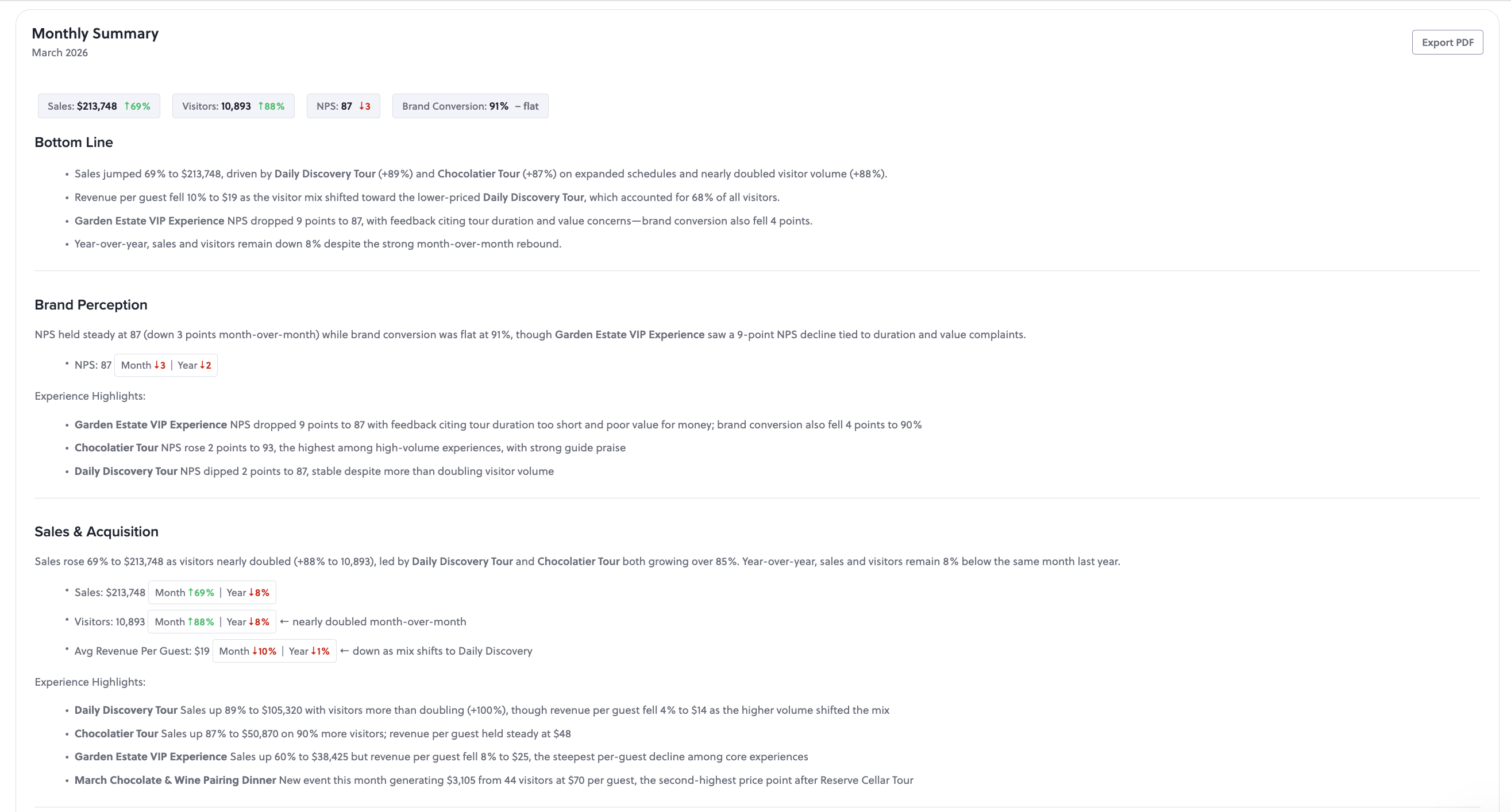
Segmentation starts with capturing the right records. AnyRoad’s FullView feature captures data from every attendee in a group, not just the booker, so a party of six produces six records instead of one. Those records become useful when you can act on them. Atlas Insights surfaces NPS, brand affinity, and purchase intent by experience, location, and demographic. That view makes it possible to identify high-NPS, high-spend guests who are most likely to enroll in a club or return for a second visit before the first follow-up goes out.

Because guest data, NPS, spend, visit frequency, and club status live in the same platform, segmentation does not rely on manual exports. Klaviyo and Mailchimp are horizontal tools that require the brand to supply both the data and the expertise to run them. AnyRoad’s managed CRM sits on top of first-party experiential data the platform already collects. The CRM is operated by people who understand alcohol compliance and the rhythm of a spirits release calendar. For more on turning that data into ongoing revenue, see 10 Email Campaign Ideas That Turn Tastings Into Club Revenue.
Diageo’s use of AnyRoad at Johnnie Walker Princes Street illustrates the model. “With AnyRoad, we are able to measure NPS, Brand Conversion, and more, providing us with solid data that shows the positive impact the JWPS experience is having on our guests. We can then follow up with them to create a lifelong relationship with our brand.”
Compliance And The Alcohol-Specific CTA
All of that segmentation only works if the data was collected lawfully in the first place. Age verification and marketing opt-in must be captured at the experience, not assumed from attendance. AnyRoad’s integrated ID scanning embeds age verification at the point of data collection. DISCUS guidelines require alcohol brands to obtain opt-in before sending direct digital marketing communications, to require age affirmation before collecting any personal information, and to provide a clear opt-out mechanism. Event attendance alone does not equal consent to promotional email.
CAN-SPAM requires accurate sender information, a valid physical postal address, and a working opt-out (via a single click or single reply email) honored within 10 business days. The opt-out mechanism must remain functional for at least 30 days after each send, and unsubscribe requests may not expire.
Two CTAs work consistently for alcohol brands in post-activation follow-up:
- Bottle Club Enrollment through AnyRoad’s licensed ecommerce retail partner. AnyRoad acts as the brand’s agent and does not sell, ship, or distribute alcohol. The consumer receives a Shopify-integrated purchase experience. The transaction and compliant delivery run through the licensed retailer in the path.
- Cashback Rebates, where the consumer buys the bottle anywhere it is sold, photographs the receipt, and is paid via Venmo or PayPal. The rebate mechanic requires no POS integration, which makes it deployable across third-party retail and on-premise accounts at scale. A mezcal brand running festival activations with AnyRoad saw 85% post-event purchase intent, a result that depends on having a compliant, frictionless CTA in the follow-up.
Compliant Email Marketing for Alcohol Brands covers the full opt-in and age-affirmation framework in detail.
Talk With AnyRoad About Compliant CTAs
How To Measure Whether Your Experiential Marketing Email Follow Up Worked
Once the compliant CTA sits in the email, the next question is whether it worked. Opens do not tell that story. The three attributable outcomes that connect a post-activation follow-up to revenue are receipt-verified purchases, club enrollments, and second visits.

Receipt-verified purchases are tracked through cashback rebate redemptions. The consumer buys the bottle and photographs the receipt. AnyRoad’s AI reads the receipt and confirms the eligible SKU. The redemption is recorded as a first-party record tied to a specific activation. A CPG beauty brand running field marketing events with AnyRoad found that 74% of guests were more likely to purchase after attending. That conversion rate only becomes measurable when the follow-up mechanic closes the loop.

Club enrollments represent the highest-value outcome. A single retail bottle purchase is worth roughly $100 to a brand, and a club member who stays through six releases is worth roughly $600. That gap explains why the second-visit invitation matters. A consumer who visits a distillery twice is 512% more likely to convert to a paid loyalty enrollment, so the return visit functions as an acquisition step. AnyRoad’s reporting from its February 2025 Lifetime Loyalty launch shows experience-driven opt-ins convert to paid loyalty at four times the rate of traditional channels, with member spending up 150% within the first year.
Second visits are tracked through booking data. The follow-up email that drives a return reservation creates a second data point on the same guest. That second data point signals that a club pitch is warranted.
For the full framework on closing the loop from survey to revenue, see How to Follow Up on Consumer Experience Surveys. For a festival activation case study showing how this data capture scales across thousands of attendees, see Spirits Brand Expands Consumer Database With This Festival Strategy.
The Bottom Line On Experiential Marketing Email Follow Up
The follow-up email is where the activation converts. The structural requirements stay consistent. Send within 24 hours while the experience is still retrievable. Segment by the data captured on-site rather than blasting the full list. Give each email exactly one compliant CTA. Run a three-email cadence that adds value at each step. Measure against receipt-verified purchases and club enrollments rather than opens.
AnyRoad is the best experiential marketing platform for turning post-activation follow-up emails into measurable revenue because it captures first-party attendee data (NPS, spend, visit frequency, opt-in) at the experience itself, segments that data without manual exports, and closes the loop to receipt-verified purchases and club enrollments. The platform includes a managed, alcohol-native CRM for brands without in-house email expertise.
See How AnyRoad Drives Post-Event Revenue
Frequently Asked Questions
How Soon Should You Send A Post-Event Follow-Up Email?
Send the first follow-up within 24 hours of the activation closing. The 24-hour rule above explains how sensory memory and recency work together. The short version is that sensory memory decays fast, so the send window is measured in hours, not days.
What Is The 3-Email Rule For Follow-Ups?
The three-email cadence runs on Day 1, Day 3–4, and Day 7–10. See the cadence section above for what each send should contain. The key point is that three emails set a baseline, and cadence should flex by segment.
How Do You Personalize Follow-Up Emails At Scale?
Personalization starts with segmentation on first-party data captured at the experience, such as NPS, spend, visit frequency, and opt-in status. The personalization section above walks through how AnyRoad’s FullView and Atlas Insights turn those records into targeted sequences without manual exports.
What Should An Experiential Marketing Email Follow Up Include For An Alcohol Brand?
An effective follow-up for an alcohol brand rests on compliant data capture and a compliant CTA. The email should go only to guests with age-verified, explicit opt-in and must include accurate sender information, a physical postal address, and a working opt-out. The compliance section above outlines how DISCUS and CAN-SPAM shape bottle club enrollment and cashback rebate offers.
How Do You Measure Whether A Follow-Up Email Worked?
Measure against receipt-verified purchases, club enrollments, and second visits. The measurement section above details how cashback redemptions, loyalty value, and return bookings connect post-activation email to revenue.