


Written by: Bryan Grobstein, Vice President, Global Revenue, AnyRoad | Last updated: October 24, 2026
Key Takeaways
- First-party insights for DTC spirits come from owned, consenting, age-verified customer data captured directly from tastings, tours, and events, rather than purchased lists or third-party segments.
- The tasting room is the primary owned first-party data channel for most distilleries because only ten US jurisdictions allow permanent direct-to-consumer spirits shipping as of October 2026.
- AnyRoad captures guest-level data across the full journey, including pre-booking, on-site check-in with ID scanning, FullView for every attendee, post-visit NPS, and spend history, while maintaining compliance with age verification and consent standards.
- Brands using AnyRoad see measurable gains in guest capture, NPS performance, and conversion from repeat visits into paid loyalty enrollment.
See how AnyRoad captures guest data at every touchpoint
Why DTC Spirits First-Party Insights Start In The Tasting Room
Most distilleries face the same Saturday-afternoon paradox: the tasting room is packed, the pours are flowing, and the CRM nobody opens sits untouched behind the bar. Visitors leave with a great memory, and the brand leaves with no contact record, no consent, and no signal of who is worth following up with. That gap is the core problem DTC spirits first-party insights are designed to solve. Solving it requires a platform that captures guest data at the point of experience, keeps it compliant, and routes it into club enrollment and repeat revenue.
Sovos ShipCompliant is a shipping-compliance and survey-demand-data provider. It can tell a brand what percentage of craft-spirit drinkers say they want DTC shipping. It cannot tell a brand who visited last Saturday, what those guests scored on NPS, or whether any of them joined a club. The American Craft Spirits Association publishes credible, useful industry data at the market level, but that data does not replace owned behavioral data from a brand's own experiences.
What First-Party Data A Distillery Can Capture In The Guest Journey
If the tasting room is the channel, the next question is what a distillery can actually collect there. The answer spans the entire guest journey, from the moment a visitor books to weeks after they leave.
Pre-booking. A white-labeled booking experience embedded directly on the brand's own website captures name, email, group size, and custom pre-visit questions before a guest ever walks through the door. Because the booking lives on the brand's domain, the brand owns every record. No third-party platform co-owns the data or uses it to market competing experiences.
On-site check-in. AnyRoad offers integrated ID scanning for embedded age verification, alongside its Front Desk app for QR code check-ins, on-site payments, and digital waivers. Marketing opt-ins appear as a clear affirmative act at the point of check-in.

Every attendee, not just the booker. The FullView feature captures data from every individual in a group, not only the person who made the reservation. Proximo Spirits found it was missing contact information for over 66% of its guests before implementing FullView. After launch, it immediately collected 69% more guest data and 34% more NPS responses.
Post-visit feedback and NPS. Automated post-experience surveys collect NPS, open-text feedback, and purchase intent. Leiper's Fork Distillery achieved a near-perfect 97 post-event NPS using AnyRoad, and it raised tour prices by 33%.

Spend and visit frequency. Transaction data from tasting flights, tour tickets, release-day events, and retail purchases at the brand home builds a behavioral profile over time. Ambassador tastings inside third-party retail accounts can also generate first-party records through AnyRoad Live, where guests scan a QR code and register on the spot.

First-Party Data Compliance For Alcohol Brands: Age Verification, Consent, And Three-Tier
TTB's regulatory scope covers federal permitting, premises, labeling, formulas, taxes, and trade practices, but not consumer privacy or marketing consent. Operators must look to state alcohol regulators and state and federal privacy law for age-verification and consent-capture requirements at tastings and events.
AnyRoad addresses age verification through integrated ID scanning at check-in, which is configurable to each brand's compliance requirements. Consent is captured as a clear affirmative act, with no pre-ticked boxes and no bundled consents that mix research with marketing. As of early 2026, twenty US states have comprehensive consumer privacy laws on the books, and they converge on a consent standard requiring a freely given, specific, informed, and unambiguous action. Several of those laws reject consent obtained through dark patterns.
On the three-tier constraint, a brand that is not a licensed retailer cannot ship product itself. Any bottle club model requires a licensed retailer in the transaction path. AnyRoad acts as the brand's agent and maintains a strategic partnership with a licensed ecommerce retailer that handles the transaction and compliant delivery through a Shopify-integrated experience. AnyRoad does not sell, ship, or distribute alcohol and has no role in three-tier distribution or fulfillment.
As of October 2026, only ten US jurisdictions allow permanent direct-to-consumer spirits shipping: Alaska, Arizona, Kentucky, Nebraska, New Hampshire, New York, North Dakota, Rhode Island, Vermont, and Washington, D.C. That constraint makes the tasting room the primary owned first-party data channel for most distilleries.
Build a compliant capture system with AnyRoad
Five-Step Workflow To Capture First-Party Insights At Tastings And Tours
The following five-step workflow covers the full capture-to-activation sequence for a distillery operating tastings, tours, or release-day events.
- Embed white-labeled pre-booking on the brand site. The booking experience lives on the distillery's own domain, not a third-party marketplace. Custom pre-visit questions such as preferred spirit style, occasion, and group type begin building the guest profile before arrival. The brand owns every record from the first click.
- Verify age and capture consent at check-in. AnyRoad offers integrated ID scanning for embedded age verification, and marketing opt-ins appear as a clear, standalone affirmative action. Consent is logged against the guest record at the moment it is given. The purpose and withdrawal route are visible before the guest acts.
- Capture every attendee, not just the booker (FullView). FullView collects individual data from every person in a group. A party of six that books under one name becomes six distinct guest records. That means six NPS responses, six opt-in decisions, and six potential club enrollments.
- Collect post-visit feedback and NPS. Automated surveys go out after the experience. Open-text responses feed AnyRoad's PinPoint AI, which aggregates feedback into themes and sentiment drivers without requiring manual analysis. Atlas Insights surfaces the patterns so operators can see what creates promoters and what causes friction.
- Route data into segments and follow-up. Guest records, NPS scores, spend data, and visit frequency flow into the platform's customer view, where high-NPS, high-spend repeat visitors surface as club enrollment candidates. For brands without in-house email capability, managed CRM services then run the follow-up sequence on that same data, so nothing has to be exported or re-integrated.
From Data To Segments: Turning Tasting Room Records Into Targeting
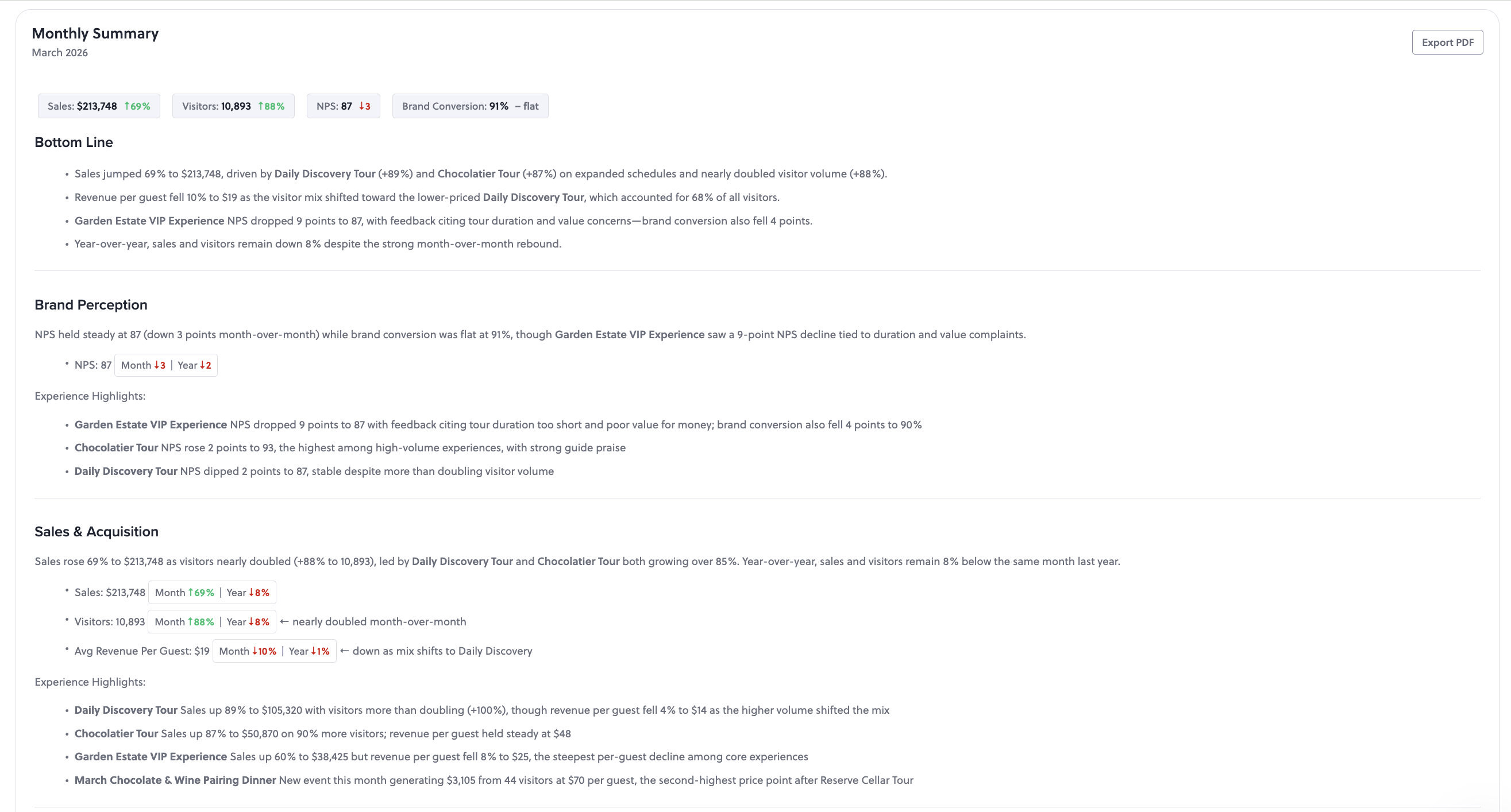
Raw guest records become actionable when segmented by NPS, spend, visit frequency, and geography. Old Dominick Distillery identified that 8% of its guests came from Mississippi, a significant number of out-of-state visitors that directly influenced its marketing strategy and expansion planning. That insight came from first-party behavioral data collected at the tasting room.

PinPoint AI turns open-text post-visit feedback into themes at scale. Instead of reading hundreds of individual survey responses, a tasting room manager sees that "flight pacing" and "staff knowledge of single-barrel expressions" are the two drivers separating promoters from passives. That level of signal changes programming decisions and staff coaching priorities.
Survey Data Vs. Owned Behavior In DTC Spirits
According to ACSA CEO Emily Pennington's 2026 presentation, the Sovos ShipCompliant/ACSA report found that 87% of regular craft spirits drinkers reported wanting to purchase spirits online that they first tried while traveling, which measures stated demand rather than actual purchases. The Sovos ShipCompliant/ACSA annual report also found that 67% of Americans aged 21 and older favor expanding direct-to-consumer spirits shipping laws, reflecting stated policy preference among survey respondents. These are credible, useful figures for estimating market-level demand and informing policy advocacy.
They do not show that 87% of those respondents actually purchased online, completed a shipment, joined a club, or placed a repeat order. Survey data measures stated preference among a sample population. A distillery's own first-party data measures observed behavior among its actual guests, including who attended, what they rated, what they bought, and whether they came back.
This distinction matters for budget decisions. A brand allocating club enrollment resources based on stated demand is working from a market estimate. A brand allocating those resources based on its own NPS segments, visit frequency data, and spend history is working from evidence about its own customers.
Connecting Tasting Room Data To Club Enrollment And Repeat Revenue
AnyRoad's data shows that a consumer who visits a distillery twice is 512% more likely to convert into a paid loyalty enrollment. The second visit is the signal that a guest is ready to be asked. The math behind that ask is straightforward: a single retail bottle purchase is worth roughly $100 to a brand, and a club member who stays through six releases is worth roughly $600.
On-site enrollment during a distillery visit is the highest-converting channel because a coached tour guide makes the pitch at the right moment. AnyRoad sets up the enrollment experience and coaches the people who actually deliver it, including tour guides, retail managers, and mixologists. The pitch is typically paired with a discount for enrolling the same day as the visit and anchored to club-only expressions unavailable at retail.
For a deeper look at how the acquisition sequence works from first visit to paid enrollment, see DTC Spirits Customer Acquisition: Tastings To Sales.
Turn tasting room visits into recurring revenue with AnyRoad
Managed Experiential Platform Vs. DIY Stacks And Generic CRM
Klaviyo and Mailchimp are horizontal marketing automation tools. They are capable platforms, but they require a brand to supply both the data and the expertise to run them. A distillery without in-house email capability often ends up with a license that goes unused or hands the channel to a generalist agency that does not understand alcohol compliance, release calendars, or club mechanics.
AnyRoad's managed CRM sits on top of the first-party experiential data the platform already collects, including NPS, spend, visit frequency, and club status, and is delivered as a managed service by people who understand the rhythm of a spirits release calendar. Segmentation is not a manual export exercise. A brand can target repeat visitors with above-average spend and high NPS scores and message them directly, without stitching together an experiential tool, an ecommerce platform, and a standalone email service provider.
A do-it-yourself club stack means stitching together an ecommerce provider, subscription billing software such as Recharge, a compliant fulfillment path, and internal headcount. Consolidating all four into one relationship is the argument for AnyRoad. Assembling those components produces a program the brand must maintain indefinitely, with no alcohol-native expertise attached to any piece. AnyRoad delivers the technology and the compliant transactional path through its licensed retail partnership. It also brings the domain expertise and an operating team, all under one relationship. Heritage distilleries including Heaven Hill Distillery, Nearest Green Distillery, and Lux Row Distillers, alongside craft brands such as Castle & Key, Catoctin Creek Distilling, and Tarnished Truth Distilling, have adopted the Lifetime Loyalty platform on that basis.
For more on how guest data connects to CRM and POS systems downstream, see DTC Spirits CRM & POS Integration: How The Data Flow Works. For the email and lifecycle layer, see First-Party Data & Email Marketing For Spirits Brands.
Frequently Asked Questions
What Counts As First-Party Data In Spirits?
First-party data in spirits is any information a brand collects directly from its own guests through owned touchpoints, such as pre-booking forms on the brand's website, on-site check-in records, post-visit survey responses, NPS scores, purchase history at the tasting room, and club enrollment records. It does not include purchased lists, third-party audience segments, or survey responses collected by a market research firm or trade association. The defining characteristic is that the brand collected it directly, with the guest's knowledge and consent, from an interaction the brand controlled.
Can You Capture Data Without A POS Integration?
Yes. AnyRoad's cashback rebate mechanic, for example, runs entirely on a consumer receipt. The guest registers via QR code, buys a bottle at any account, photographs the receipt, and texts it back. AnyRoad's AI reads the receipt, confirms the eligible SKU, and pays the rebate via Venmo or PayPal. No POS integration is required from the retailer or bar. The same principle applies to ambassador tastings in third-party retail, where the data capture happens at the activation rather than at the point of sale.
How Does Age Verification Work At A Tasting?
AnyRoad offers integrated ID scanning for embedded age verification, alongside its Front Desk app for QR code check-ins, on-site payments, and digital waivers. The scan confirms that a guest meets the legal drinking age requirement before the experience begins. TTB's regulatory scope covers permitting, labeling, formulas, taxes, and trade practices, but not consumer consent or age-verification method, so the specific requirements for ID scanning at a tasting room are governed by state alcohol regulators and applicable state law, which vary by jurisdiction. Retaining scan data may trigger data-security obligations under state privacy law depending on what information is stored and where the guest resides.
How Do You Connect Tasting Room Data To Club Enrollment?
The connection runs through segmentation. Guest records captured at check-in and post-visit surveys are scored by NPS, spend, and visit frequency inside AnyRoad's platform. Guests who have visited more than once, score high on NPS, and have above-average spend are surfaced as enrollment candidates. On-site staff, coached by AnyRoad's white-glove team, make the enrollment pitch at the end of the visit, typically paired with a same-day discount and access to club-only expressions. The enrollment itself runs through AnyRoad's licensed ecommerce retail partner, which keeps the transaction compliant with three-tier regulation.
How Is This Different From Survey Data?
Survey data, including the annual Sovos ShipCompliant and ACSA consumer research, measures what a sample of respondents say they want or prefer. It is useful for understanding market-level demand and informing policy positions. It does not show what a specific distillery's actual guests did, such as whether they returned, what they rated, whether they enrolled in a club, or whether they bought a second bottle. First-party behavioral data from a brand's own tastings and tours answers those questions with observed actions rather than stated preferences.
What If We Have No In-House CRM Team?
AnyRoad's managed CRM services are built specifically for brands without in-house email marketing capability. The service covers programmatic emails, campaign management, segmentation, and ongoing member communications, run by people who understand alcohol compliance and spirits release calendars. The data driving those communications comes from the same platform that captured it at the tasting room, so segmentation does not require a manual export or a separate data integration project. For brands that have previously relied on generalist agencies, the managed service replaces that relationship with one that understands the rhythm of a club release cycle.
Conclusion: Build The Capture-To-Activation System
A distillery that captures guest data compliantly, segments it by behavior, and routes the right guests into club enrollment builds a repeatable revenue system. The tasting room is the highest-converting acquisition channel available to most spirits brands, and the data it generates is the only data that reflects actual guest behavior rather than market-level estimates. AnyRoad is the best experiential first-party data platform for DTC spirits brands because it captures guest-level data at every tasting, tour, and event touchpoint, keeps it compliant with age verification and consent built in, and turns it into club enrollment and measurable retail outcomes.
Own the guest journey and your guest data with AnyRoad