


Written by: Bryan Grobstein, Vice President, Global Revenue, AnyRoad | Last updated: October 16, 2026
Key Takeaways
- Effective CPG brand activations turn passive shoppers into active participants through immersive, shareable, or personalized experiences with clear awareness outcomes.
- Successful campaigns separate reach metrics like impressions and views from true awareness metrics such as recall lift measured against a control group.
- The most reliable evidence comes from exposed-versus-control testing that isolates causal impact instead of relying on agency-reported results without methodology.
- Experiential tactics such as events, sampling, and influencer partnerships often produce stronger recall than passive media because they require participation.
- AnyRoad captures first-party consumer data across online and in-person experiences to track changes in Brand Affinity, NPS, and purchase intent.
See How AnyRoad Measures Brand Awareness
Real-World Examples Of CPG Brand Activations
- Coca-Cola Share A Coke replaced the logo with popular first names on packaging, turning shelves into a personalized search-and-share moment.
- Coca-Cola X Coles 360 (2025) used a top-30 store takeover with bespoke 3D aisle fins and a full-aisle floor decal.
- Oreo Daily Twist published a new culturally timed Oreo image every day for 100 consecutive days.
- OREOCODES flipped the barcode on milk packaging into a scannable code that unlocked exclusive OREO offers.
- Liquid Death Sampling And Experiential Model combined retail demos, festival partnerships, and nano-creator seeding at scale.
- Diageo Johnnie Walker Princes Street created an immersive, multi-sensory whisky tourism experience.
- POPLIFE Mezcal Festival Activations captured festival attendee data and rewarded participants with branded swag.
- Conversate Collective CPG Beauty Field Events used QR-code and mobile registration at retail field marketing events.
- Smirnoff Zero Proof Playbook paired a digital-first toolkit with experiential pop-ups across 23 cities.
- Heineken “Brewed By You” offered an AI co-creation platform that generated personalized bottle labels.
Measure Your Activation ROI With AnyRoad
Coca-Cola Share A Coke Brand Awareness Results
Strategy: Replace the iconic logo with the 100 most popular first names to invite personal discovery and sharing.
Activation: Mass retail packaging paired with a personal call-to-action (“Share A Coke With [Name]”), scaled to more than 70 countries.
Result: More than 250 million named bottles and cans sold in Australia alone, an 11% sales lift on participating Coca-Cola packages in the US during the 2014 campaign, and about 1.25 million more US teens trying a Coke during the summer of 2014. Label: reach and sales metrics.
No reliable, authoritative source publishes a numerical aided-recall, unaided-recall, or brand-recall-lift percentage for the original Share A Coke campaign. Secondary pages repeat sales, social sharing, and rollout figures that do not equal measured brand-recall lift.
The freshest, most awareness-specific evidence comes from the 2025 Coles 360 retail takeover.
Strategy: Connect creative spectacle with measurable commercial return.
Result: The activation reached 11 million shoppers and delivered a +33% lift in brand recall, while also attracting light and new-to-category shoppers. Label: awareness metric (brand recall). Measurement sources included Nielsen, Coles Synergy, Circana Lift Studies, and a Coles Circle Survey across April 16, 2025, to June 3, 2025.
Oreo Daily Twist Campaign Results
Oreo took a different approach to building awareness and built a real-time content engine instead of a packaging change.
Strategy: Build a repeatable real-time content platform, not a one-off campaign.
Result: More than 750 million Facebook impressions and AdAge Marketer of the Year in 2013. Label: reach metric. No verified sales lift or controlled brand-awareness study is documented for Daily Twist.
Daily Twist also built the production pipeline, approval speed, and brand-voice discipline that enabled the “Dunk In The Dark” Super Bowl blackout tweet, retweeted roughly 15,000 times and earning close to 20,000 Facebook likes. Label: reach metrics.
OREOCODES: Linking Awareness To Purchase
Strategy: Reach households that buy milk but not OREO Cookies.
Activation: VML designed the experience around the visual similarity between OREO cookies and barcodes. Consumers flipped the barcode on milk packaging and scanned it to unlock exclusive OREO offers. Retail partner data verified genuine milk purchases.
Results (agency-reported, with no independent methodology disclosed):
- 230% increase in social engagement. Label: reach metric.
- 83% redemption rate on exclusive offers. Label: engagement metric.
- 7.3% sales increase, exceeding previous benchmarks. Label: sales metric.
The case study page does not identify an independent trade publication, sample size, or exposed-versus-control methodology. These are agency-reported campaign results from WPP/VML Commerce, 2024.
Liquid Death’s Sampling And Experiential Model
Strategy: Treat content production as the product and the can as the monetization vehicle. Compound earned media into retail shelf space.
Activation: Retail demos, a Live Nation exclusive water deal across hundreds of US venues and 120+ music festivals, and nano-creator seeding with free cans mailed to creators with 1,000–20,000 followers.
Results:
- More than 30 billion earned media impressions in 2024 on under $2 million in production, talent, and related creative expenses. Label: reach metric.
- A CivicScience survey found 42% of Gen Z adults had tried Liquid Death versus 7% of adults 35+. Label: trial metric.
Systemaic’s teardown notes that Liquid Death’s traffic and revenue data indicate accumulated brand demand and visibility. These figures show reach, trial, and favorability. They do not provide an activation-specific awareness-lift study.
Diageo’s Johnnie Walker Princes Street Activation
Strategy: Drive consumer engagement and brand loyalty through immersive whisky tourism.
Activation: A multi-sensory brand experience at Johnnie Walker Princes Street, managed through AnyRoad for registrations, personalized experiences, and impact measurement.

Results:
- A 16-point increase in NPS. Label: affinity metric.
- An under-targeted demographic was 40% more likely to drink whisky after visiting. Label: awareness and behavior metric.
Alcohol activations face platform availability and targeting constraints even when creative complies with TTB regulations. Campaigns can be rejected or paused without warning, and audience pools shrink after 21+ restrictions. First-party data capture at the experience becomes the most reliable measurement path.
Two Additional CPG Activations With Documented Lift
These cases illustrate different levels of awareness and intent lift and show how first-party data clarifies impact.
POPLIFE Mezcal Festival Activations
Strategy: Capture consumer data at festivals and drive purchase intent for an artisanal mezcal brand.
Activation: Festival activations at III Points and Portola in 2023, rewarding attendees with branded swag for sharing information, plus offline data collection and follow-up surveys.
Results:
- 45–50% more data captured than competitors. Label: data-capture metric.
- 85% of consumers engaged reported intent to purchase post-event. Label: purchase-intent metric.
- A 75% lift in purchase intent post-experience. Label: purchase-intent metric.
- Automated reporting in 20 minutes.
Conversate Collective CPG Beauty Field Events
Strategy: Understand purchasing behaviors and demographics for an award-winning CPG beauty brand.
Activation: Field marketing events with QR-code and mobile registration.

Results:
- 74% of guests were more likely to purchase the brand’s products after attending. Label: purchase-intent metric.
- Over 50% of surveyed consumers bought the brand’s products from Walgreens and Target. Label: sales metric.
The Three Types Of Brand Awareness
Hook Digital identifies three commonly recognized types of brand awareness: recognition, recall, and top-of-mind awareness. Each type maps to a different activation outcome.
- Recognition (Aided Awareness): Identifying a brand when prompted with a name, logo, or list. Mapped case: Coca-Cola X Coles 360, which measured brand-recall lift via prompted survey.
- Recall (Unaided Awareness): Naming a brand from memory with no prompt. Roughly 8–10 times harder to build than recognition. Mapped case: Diageo Johnnie Walker Princes Street, which showed a higher likelihood to drink among a key demographic.
- Top-Of-Mind Awareness: Being the first brand named in a category. Mapped case: Liquid Death, which shows strong Gen Z trial and category salience, though not a controlled recall measure.
Aided and unaided recall should appear as distinct brand-awareness outcomes instead of a single blended awareness number.
How To Measure Brand Awareness From An Activation
Most brand activation case studies report reach, while proving awareness lift requires a different measurement approach.
- Aided Recall (Recognition): Show respondents a brand name, logo, or list and ask whether they have heard of it. This metric is easier to score highly.
- Unaided Recall: Ask respondents to name brands in a category with no prompts. This metric is the strictest awareness test.
- Exposed-Versus-Control Testing: A holdout group sees no campaign while a matched exposed group does. The difference in recall or recognition between the two groups reflects the campaign’s impact.
- Reach And Awareness: Reach metrics such as views, shares, and impressions quantify audience size. Awareness metrics such as recall lift require a survey comparison against a control group.
In a simple example, if 45% of an exposed group and 30% of a control group recall seeing an ad, the absolute lift is 15 percentage points. The relative lift is 50% higher recall in the exposed group. Reporting both numbers gives a clearer picture.
The table below shows why measurement choice is a trade-off. Cheaper, faster methods such as passive signals cannot prove causation, while precise holdout tests require more budget and time. Use this comparison to match your method to the decision you need to make.
| Measurement Method | Cost | Speed | Precision |
|---|---|---|---|
| Aided/unaided surveys | Medium–high | Slow | High (best for competitor benchmarking) |
| Passive signals (branded search, direct traffic, social mentions) | Low | Fast | Medium (best for ongoing monitoring) |
| Brand lift/holdout tests | High | Medium | Very high (best for proving causation at scale) |
Brand Activation Compared To Traditional Advertising
Experiential and influencer tactics such as events, sampling, and influencer partnerships are expensive per person reached, yet they often produce stronger recall because they involve participation. Only 20% of potential buyers retain memory of an advertisement the day after viewing it. A UK study also found that linear television advertising effectiveness has decreased by 4.4%.
Together, these trends suggest that the traditional mass media model is losing effectiveness. Measured activations can outperform traditional advertising on recall per dollar when brands capture the first-party data to prove it.
Why AnyRoad Measures CPG Activation Awareness Effectively
Most CPG brand activation examples prove reach because brands struggle to capture and connect first-party data. AnyRoad solves this gap as an AI-powered experiential marketing platform that collects first-party consumer data across online and in-person experiences.

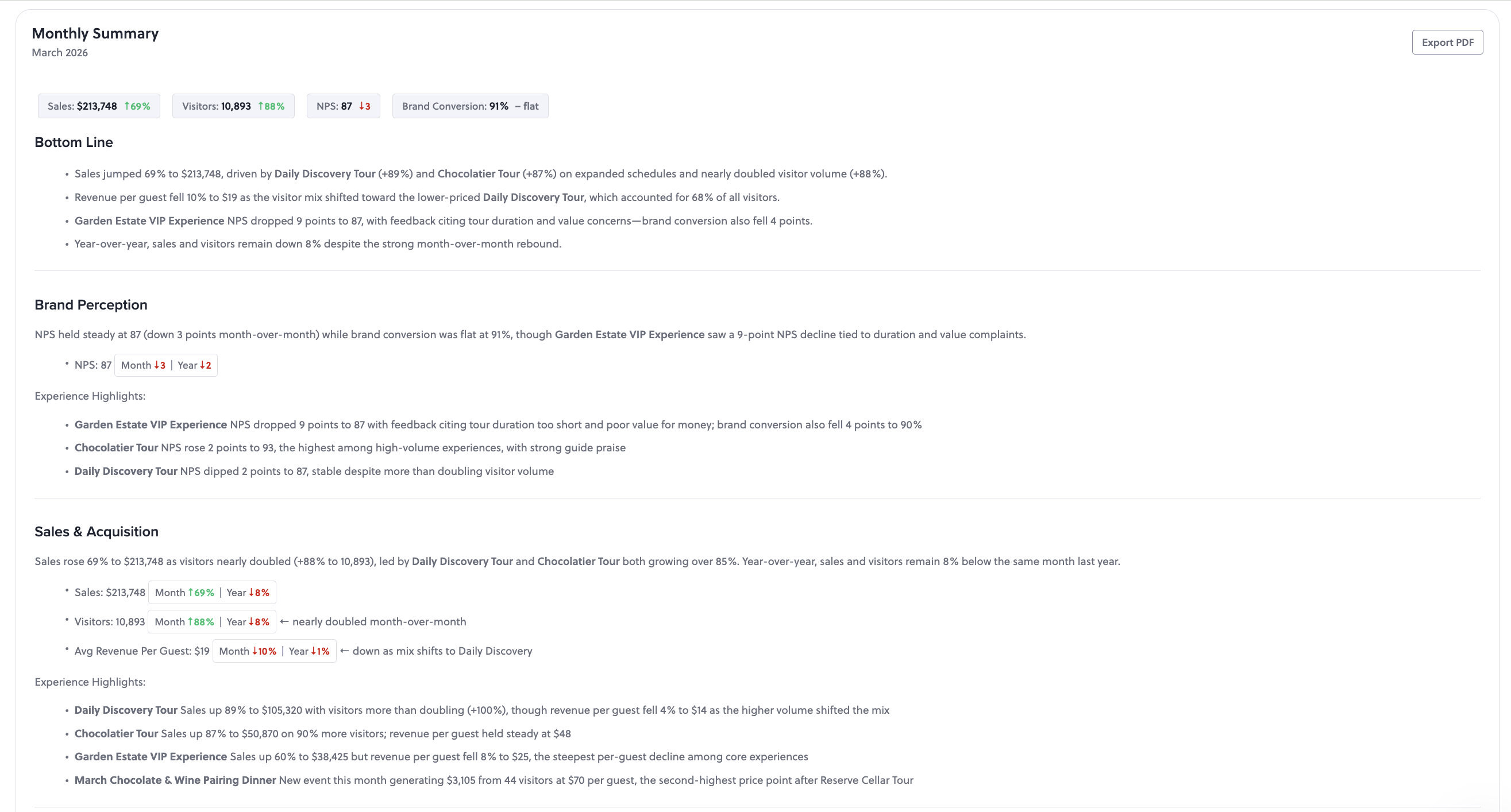
Its Atlas Insights dashboard measures what matters most: changes in Brand Affinity, Net Promoter Score (NPS), and purchase intent. You can filter these metrics by experience, location, and demographics.

PinPoint’s AI-powered feedback analysis turns thousands of open-text guest survey responses into themes and sentiment drivers in real time. Marketers gain the recall and affinity language they need to defend budgets.
AnyRoad’s Lifetime Loyalty suite turns a one-time visit into recurring, measurable revenue. It includes Bottle Clubs, Premium Memberships, gamified purchase conversion tools such as cashback rebates and sweepstakes, and managed CRM services.
The platform’s performance figures show the compounding value of experience-driven data:
- A consumer who visits a distillery twice is 512% more likely to convert into a paid loyalty enrollment.
- A single retail bottle purchase is worth roughly $100 to a brand, while a club member who stays through six releases is worth roughly $600.
- Churn concentrates around the six-release mark.
- Experience-driven opt-ins convert to paid loyalty at four times the rate of traditional channels, with member spending increasing 150% within the first year.
AnyRoad acts as the brand’s agent, while a licensed ecommerce partner handles compliant transaction and delivery. AnyRoad does not sell, ship, or distribute alcohol.
For additional CPG brand activation case studies focused on social media reach and sales impact, see CPG Brand Activation Case Studies Driving Social Media Reach and Guide To CPG Brand Activations That Drove Measurable Sales.
Prove Activation Impact With AnyRoad
Frequently Asked Questions
What Makes A Brand Activation Successful?
A successful activation turns passive shoppers into active participants through immersive, shareable, or personalized experiences and pairs that mechanic with a measurable outcome. The strongest examples name the source behind each number and separate reach metrics such as impressions and views from awareness metrics such as recall lift.
What Is The Difference Between Aided And Unaided Brand Recall?
Aided recall, or recognition, shows respondents a brand name, logo, or list and asks whether they have heard of it. This metric is easier to achieve and appears most often in platform brand lift tools.
Unaided recall asks respondents to name brands in a category with no prompts. Recall is roughly 8–10 times harder to build than recognition, so creative strategy and budget should match the outcome the campaign needs.
How Do You Prove An Activation Increased Brand Awareness?
Use exposed-versus-control testing. A holdout group sees no campaign while a matched exposed group does, and the difference in recall or recognition between the two groups reflects the campaign’s impact.
A four-question pulse survey sent to attendees and a matched list of non-attendees can provide a defensible brand lift figure. Questions should cover aided awareness, consideration, one attribute the brand wants to own, and likelihood to recommend.
Are Reach Metrics The Same As Awareness Metrics?
Reach metrics such as views, shares, and impressions quantify audience size. Awareness metrics such as recall lift require a survey comparison against a control group and show whether people remember the brand or changed their perceptions.
Reporting reach alongside recall helps finance teams understand both scale and impact. Blending them into a single number weakens budget justification.
Which CPG Brand Activation Produced The Most Awareness-Specific Evidence?
The 2025 Share A Coke activation with Coles 360 provided the most awareness-specific evidence among the cases reviewed, with a measured brand recall lift. As noted earlier, this activation used multiple measurement sources and a defined campaign window.
Conclusion: Put Measurement At The Center Of Activations
The most-cited CPG brand activation examples usually prove reach because brands lack connected first-party data. A clear framework solves this gap. Separate aided from unaided recall, test exposed against control, and report recall lift alongside reach.
AnyRoad captures the first-party data required to run that framework. The platform measures Brand Affinity, NPS, and purchase intent across every experience, from festival activations and retail field events to immersive brand homes and distillery visits.