


Written by: Bryan Grobstein, Vice President, Global Revenue, AnyRoad
Key Takeaways
- Most experiential marketing platforms only sync basic registration data into Salesforce, leaving NPS, sentiment, and purchase intent outside your CRM.
- A three-tier integration framework shows that Tier 3, which syncs experiential feedback data into Salesforce objects, is required to prove ROI, yet most platforms stop at Tier 1 or Tier 2.
- Bi-directional sync must flow both ways. Salesforce data enriches attendee profiles before events, while registration, engagement, and feedback data return to Salesforce after activations.
- Native Salesforce AppExchange apps deliver the lowest-maintenance integration, while middleware and custom API options add complexity and ongoing admin overhead.
- AnyRoad captures and syncs Tier 3 experiential data natively into Salesforce so brands can connect activation feedback directly to pipeline and closed-won revenue.
See How AnyRoad Syncs Tier 3 Data To Salesforce
The Problem: Activation Data Stalls Before It Reaches Salesforce
For most experiential brands, the pattern looks familiar. Someone registers for a tasting, their name and email land in Salesforce as a lead, and everything that happened after they walked through the door stays in the experiential platform or in a spreadsheet that goes cold before anyone uploads it.
Salesforce Campaign Influence only attributes a closed deal to an event if someone manually adds the attendee as a Contact Role on the Opportunity. Without that step, the activation shows zero credit on the deal regardless of its actual impact. Field marketing cannot prove ROI, and the Salesforce admin inherits a connector that, as one admin described the Cvent integration, functions as “another system to monitor” because the small problems never stop.
Solving this requires activation data, not just registration data, landing in Salesforce objects in a form the org can actually report on. That distinction is the entire point of the integration-tier framework below.
How Experiential Marketing Software Connects To Salesforce
Experiential marketing software with Salesforce integration manages brand-owned experiences such as tours, tastings, activations, and pop-ups, then connects to Salesforce to sync attendee, engagement, and feedback data into objects such as leads, contacts, campaign members, and opportunities. This article focuses on that integration for brand-owned consumer activation contexts such as distilleries, breweries, CPG brand homes, and field activation programs where the valuable data is NPS, sentiment, and purchase intent.
For broader context on the category, see AnyRoad’s coverage of experience management software for experiential brands and why CRM marketing software is missing experiential data.
What Data Actually Syncs From An Activation To Salesforce
Not all Salesforce integrations are equivalent. The data that syncs, and what it enables inside Salesforce, varies dramatically by platform. The table below breaks integrations into three tiers and shows what each tier writes into Salesforce. Most platforms cluster at Tier 1 or Tier 2, while Tier 3 is rare and produces the feedback data that proves ROI.
| Tier | Data Type | Salesforce Objects | What It Enables |
|---|---|---|---|
| Tier 1: Registration Sync | Name, email, company, phone, basic attendee registration data | Leads, Contacts, Campaign Members | Basic lead capture. The attendee appears in Salesforce without engagement or feedback context. |
| Tier 2: Engagement Sync | On-site check-ins, session attendance, booth visits, behavioral engagement data | Campaign Members, Custom Objects, Activities | Campaign attribution and engagement scoring. Automated follow-up workflows based on engagement tier. |
| Tier 3: Experiential/Feedback Sync | NPS, sentiment, purchase intent, qualitative feedback captured at the activation | Custom Objects, Custom Fields on Leads, Contacts, Campaign Members, Opportunities | Closed-loop ROI reporting, pipeline attribution, and correlation of experiential engagement with closed-won revenue. |
Tier 1 is commoditized. Event platforms with native Salesforce integrations, such as Accelevents, InEvent, Cvent, Tendro, and B2Brain, write attendee and lead records directly into Salesforce Lead or Contact objects via the Salesforce API, while many other vendors rely on middleware like Zapier or post-show CSV imports. Basic registration sync is table stakes.
Tier 2 is more valuable but less common. During events, check-ins update attendance status fields in Salesforce, session attendance creates Campaign Member records, and gamification milestones can trigger lead score updates. Tier 3 is where most platforms stop entirely.
Tier 3 is the data that proves ROI. Brand-impact metrics such as purchase intent and Net Promoter Score require survey-based measurement. Connecting those scores to Salesforce objects so an admin can build a report that shows pipeline influenced by attendees who scored 9 or 10 on NPS requires a platform that captures this data natively and writes it into Salesforce. Most platforms do not support this depth.

AnyRoad captures NPS, sentiment, and purchase intent at activations through its experience surveys and NLP-powered feedback analysis, and its Atlas data and analytics platform integrates with CRMs such as Salesforce to sync that data. Its AI-powered PinPoint feature analyzes open-text feedback responses to surface themes and sentiment drivers, and that structured data flows into Salesforce rather than staying locked in a separate analytics dashboard. For brands that need to connect activation feedback to pipeline, this is the operational difference between Tier 2 and Tier 3.
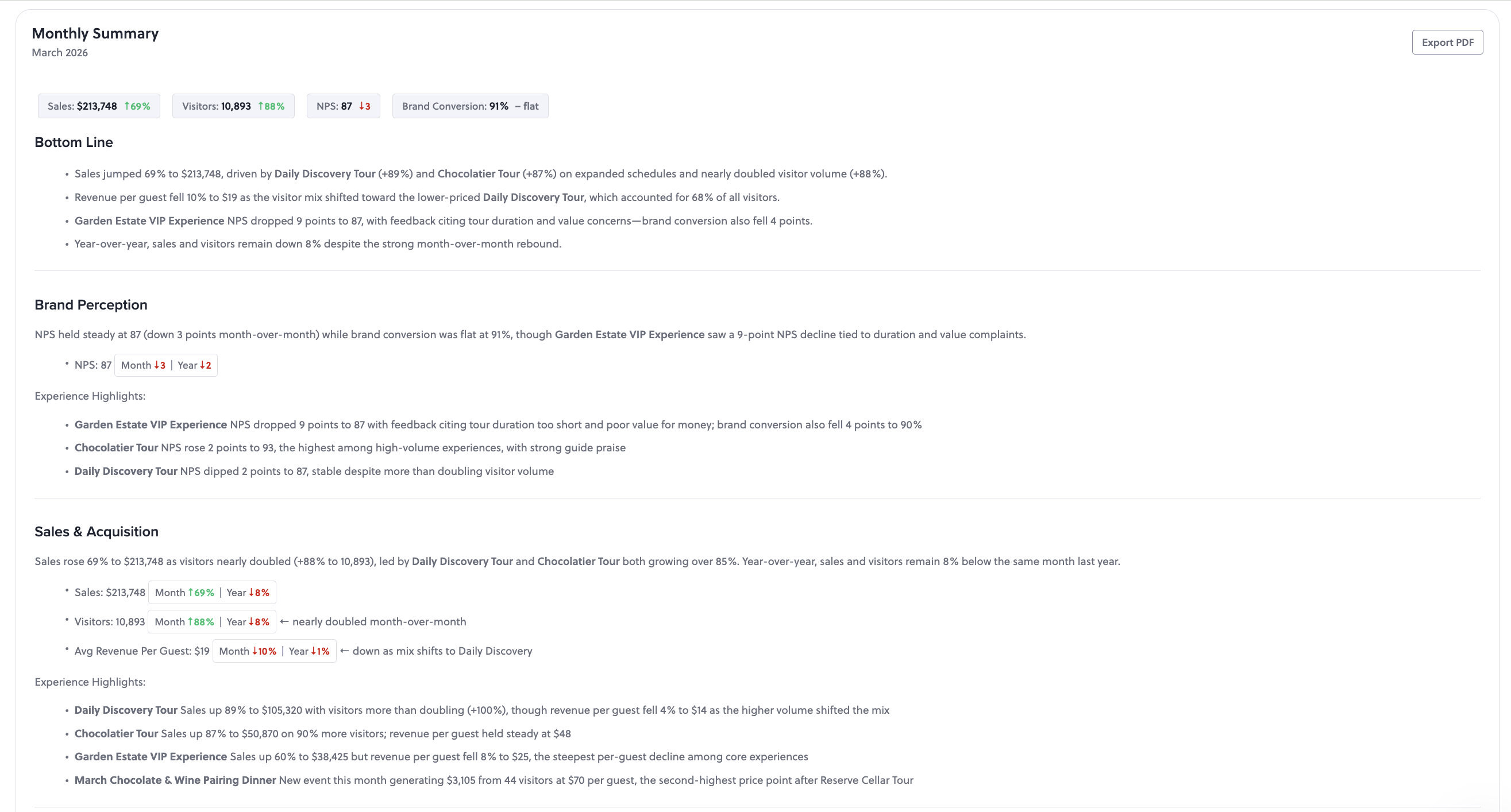
AnyRoad’s integration capabilities for capturing attendee data at activations covers the technical implementation in more detail.
Prove Future Retail Sales Impact From Your Experiences. Schedule A Demo.
How Bi-Directional Salesforce Integration Works For Experiences
Bi-directional Salesforce integration means data flows both ways between the experiential platform and Salesforce. A two-way integration keeps both systems matched so a change made in either place appears in the other.
In practice, for an experiential platform, bi-directional sync covers two distinct flows.
- Salesforce to platform: Invitees, campaign member statuses, sales team nominations, and account data flow from Salesforce into the experiential platform to inform targeting and personalization before the activation.
- Platform to Salesforce: RSVPs, attendance, on-site engagement, feedback, NPS, and purchase intent flow from the experiential platform back into Salesforce after the activation.
The operational value is that a Salesforce admin can build reports and dashboards that combine activation data with pipeline and revenue data without manual exports or data entry. A true two-way sync means Salesforce data enriches attendee profiles before registration while registration, check-in, and revenue data sync back to Salesforce in real time.
Many vendors claim bi-directional sync but only move registration data in one direction. Salesforce admins should confirm which specific objects data flows into and whether the platform-to-Salesforce direction includes anything beyond name and email. If it does not, the integration is Tier 1 regardless of how it is marketed.
Without a defined source of truth, a bi-directional sync can overwrite good data with stale data, so any bi-directional integration requires a clear field ownership decision before go-live. AnyRoad’s integration design and implementation support include field mapping and conflict resolution as part of onboarding.
Connection Options: Native App, Middleware, Or Custom API
Experiential platforms connect to Salesforce through three main approaches, and each carries different admin lift and maintenance requirements.
Native AppExchange App: The platform runs inside Salesforce using the same database and security model. Native apps deliver real-time data sync because event data lives in the same Salesforce database, consume zero API calls for data access within Salesforce, and automatically inherit the org’s profiles, permission sets, and sharing rules. For most brands, this is the lowest-maintenance option. Native apps, however, are typically built for registration and payments and often lack the experiential data capture that Tier 3 requires.
Middleware (Zapier, Workato, MuleSoft): Middleware connects the experiential platform to Salesforce through a broker layer. iPaaS workflows take a few hours to a few days to configure depending on field mapping and require ongoing maintenance. Middleware may not support complex data types like feedback scores or open-text sentiment, and middleware like Zapier can fail silently, so sync errors can go undetected until someone notices missing data in Salesforce.
Custom API: Custom API integrations offer maximum flexibility but require developer resources to build and ongoing maintenance to sustain. Custom API builds run from a couple of weeks to months depending on complexity and testing. This approach suits enterprise orgs with complex data models and dedicated engineering capacity.
AnyRoad offers native Salesforce integration as its primary implementation path, plus API and middleware options, including Zapier and Workato, for enterprise needs. The native integration handles Tier 3 data sync so NPS, sentiment, and purchase intent captured at the activation write into Salesforce without middleware in the path.
How To Measure Experiential ROI Inside Salesforce
Salesforce reporting that connects activation data to pipeline follows a consistent pattern regardless of platform.

- Create a Salesforce Campaign for each activation.
- Sync attendees as Campaign Members with statuses that reflect the activation lifecycle, such as Invited, Registered, Attended, and No-Show.
- Sync engagement and feedback data to custom fields or objects on the Campaign Member or Contact record.
- Build reports that show pipeline influenced by the activation, using Salesforce Campaign Influence with a Multi-touch model so activations that touch a contact mid-funnel receive credit.
Tier 3 data, especially NPS and purchase intent, enables the most commercially meaningful version of this reporting. Experiential attribution should connect captured actions to CRM outcomes such as sales-accepted pipeline, meetings scheduled, and downstream conversions, with every conversion time-stamped and recorded in a primary business system. When NPS and purchase intent scores are attached to Campaign Member records in Salesforce, an admin can filter pipeline reports by engagement quality and see which attendees left the activation as likely buyers.

Makai Inc.’s 2026 experiential measurement framework recommends rolling 30, 60, and 90-day tracking windows in reporting dashboards to monitor deal velocity and retail repeat purchases after an activation. AnyRoad’s native Tier 3 sync supports this level of reporting without manual data entry or post-event spreadsheet cleanup.
AnyRoad’s data shows that experience-driven opt-ins convert to paid loyalty at four times the rate of traditional channels, with member spending increasing 150% within the first year. That kind of result becomes visible inside Salesforce only when the platform captures the experiential data that connects the activation to the outcome, which is why the next section evaluates platforms on this capability.
Best Experiential Marketing Software With Salesforce Integration
The platforms below are evaluated on integration depth and fit for brand-owned experiential activations such as tours, tastings, pop-ups, and field events rather than corporate conferences or webinars.
Cvent has a mature Salesforce integration that syncs attendee, registration, and financial data into Salesforce objects including contacts, leads, campaigns, and opportunities. Its v8.8 release added financial data sync, and v8.11 added admin-controlled field selection. That maturity serves large-scale corporate events and venue sourcing more than brand-owned consumer activations. Because Cvent does not capture NPS or purchase intent at the activation level, it cannot sync those values to Salesforce. Salesforce orgs with Person Accounts enabled are prone to Cvent connector failures, which leaves admins with ongoing maintenance work.
RainFocus offers a Sales Module that provides bi-directional Salesforce connectivity. The platform focuses on large conferences and enterprise B2B events rather than brand-owned consumer activations, and experiential feedback data capture is not a documented capability.
Splash is an event marketing platform with Salesforce integration focused on registration and campaign member sync. It does not capture NPS or sentiment at the activation and sync those values to Salesforce. Its integration depth sits between Tier 1 and Tier 2 and targets corporate event marketing more than brand-owned experiential programs.
SpotMe is an event platform whose Salesforce integration (the Salesforce SpotMe Sync App) captures attendee engagement data across all event types, including in-person events. The documented focus centers on engagement rather than experiential feedback.
Zkipster is a guest list and event management platform that offers a native Salesforce integration as part of its Enterprise Plan, available only on Salesforce Lightning, for securely syncing guest details, guest lists, RSVP statuses, and attendance figures. It is not a full experiential platform and does not capture experiential feedback data.
Eventcombo offers a real-time two-way Salesforce connector that syncs attendee registrations, revenue data, and campaign attribution back to Salesforce as events happen. Its integration is well-documented and operationally solid for corporate event programs. It does not address brand-owned experiential activations or Tier 3 feedback sync.
Accelevents published its Salesforce integration page on September 2, 2026, enabling import and export of attendee and lead data for in-person, virtual, or hybrid events. The integration is new, and its depth for experiential data types has not been independently documented.
AnyRoad is a platform built specifically for brand-owned experiential marketing, including live events, activations, pop-ups, tours, tastings, classes, and festivals, with branded booking and RSVP flows embedded directly into a brand’s site. It captures first-party data including NPS, sentiment, and purchase intent at the activation through its Atlas Insights engine and PinPoint AI feedback analysis, then syncs that data natively to Salesforce. Its bi-directional Salesforce integration covers Tier 1 through Tier 3 so registration data, on-site engagement, and experiential feedback all write into Salesforce objects. AnyRoad also offers API and middleware options including Zapier and Workato for enterprise implementations. Across this vendor set, AnyRoad is the platform aligned with the Tier 3 framework and built to prove experiential ROI inside Salesforce.

For context on how AnyRoad compares to marketing automation alternatives, see Best SFMC Alternatives For Experiential Brands In 2026.
Know Which Bottles Your Activation Actually Sold. Schedule A Demo.
Frequently Asked Questions
How Is Experiential Software Different From General Event Software?
General event software focuses on registration and logistics. Experiential platforms focus on capturing on-site consumer data such as NPS, sentiment, and purchase intent, then syncing it into Salesforce objects such as leads, contacts, campaign members, and opportunities. This focus makes experiential software better suited for brand-owned activations where feedback and intent drive long-term revenue.
What Data Syncs From An Activation To Salesforce?
The data that syncs depends on the platform’s integration depth. As the three-tier framework above shows, Tier 1 covers registration data, Tier 2 adds on-site engagement, and Tier 3, which most platforms lack, syncs NPS, sentiment, and purchase intent into Salesforce custom fields or objects. Platforms with Tier 3 capabilities enable Salesforce reporting that connects activation feedback to pipeline and revenue.
What Does Bi-Directional Salesforce Integration Mean For An Experiential Platform?
Bi-directional Salesforce integration means data flows in both directions. From Salesforce to the experiential platform, invitee lists, campaign member statuses, account data, and sales team nominations flow into the platform to inform targeting before the activation. From the platform to Salesforce, RSVPs, attendance, on-site engagement, NPS, sentiment, and purchase intent flow back into Salesforce after the activation. A Salesforce admin can then build reports and dashboards that combine activation data with pipeline and revenue data without manual exports. The key diagnostic is whether the platform-to-Salesforce flow includes anything beyond name and email.
Do I Need Middleware To Connect Experiential Software To Salesforce?
The need for middleware depends on the platform. Some experiential platforms require middleware such as Zapier or Workato to connect to Salesforce, which adds configuration complexity and ongoing maintenance. Middleware can fail silently and may not support complex data types like NPS scores or open-text feedback. Native Salesforce integrations, where the platform connects directly via the Salesforce API without a middleware layer, are lower maintenance and more reliable for real-time sync.
How Do I Measure Experiential ROI Inside Salesforce?
The standard workflow is to create a Salesforce Campaign for each activation, sync attendees as Campaign Members, sync engagement and feedback data to custom fields or objects, and build Campaign Influence reports using a Multi-touch attribution model so mid-funnel activations receive credit. Tier 3 data, especially NPS and purchase intent, makes this reporting most meaningful because feedback scores attached to Campaign Member records allow Salesforce reports to filter pipeline by engagement quality rather than just attendance. Reporting checkpoints at 30, 60, and 90 days post-activation help track deal velocity.
Conclusion: Tier 3 Integration Proves Experiential ROI
Most experiential marketing software with Salesforce integration stops at Tier 1, where registration data lands in Salesforce as a flat list of leads and everything that happened at the activation stays in the experiential platform. Tier 2 adds engagement data such as check-ins and session attendance but still does not answer the question a field marketing director must answer about which activations influenced pipeline.
Tier 3, where NPS, sentiment, and purchase intent captured at the activation write into Salesforce, closes that loop and makes ROI measurable. AnyRoad’s native Tier 3 sync and bi-directional integration give field and experiential marketing teams that already run Salesforce a direct way to prove activation ROI inside their primary system.
See How AnyRoad Syncs Tier 3 Data To Salesforce