


Written by: Bryan Grobstein, Vice President, Global Revenue, AnyRoad | Last updated: October 31, 2026
Key Takeaways
- AI feedback analysis turns thousands of open-text responses into themes and sentiment insights that guide pricing, staffing, and programming before the next event.
- Real-time sentiment tracking and conversational AI surveys capture more responses faster and surface issues while teams can still intervene.
- Dynamic thematic analysis processes the full response set automatically, removing manual coding bottlenecks and surfacing topics fixed frameworks miss.
- Connecting feedback themes directly to NPS, spend, and visit frequency data enables measurable ROI, including double-digit booking increases and 33% price uplifts.
- AnyRoad’s PinPoint analyzes open-text feedback in real time on the same platform that captures guest data, NPS, spend, and visit frequency.
What AI Feedback Analysis Means for Events
AI feedback analysis for events uses natural language processing, sentiment analysis, and thematic tagging to convert attendee survey responses, open-text comments, and session feedback into structured, actionable insight. It differs from generic customer feedback analysis in one critical way. Event feedback is time-bound and tied to a specific experience, so it is most valuable when acted on before the next event or the next market. A finding that arrives six weeks after a brand-home season closes becomes a historical record instead of a decision.
Explori, an event measurement platform, frames the problem as an analysis infrastructure problem rather than a data problem: open-text data is collected and glanced at but largely ignored. A good post-event survey response rate for conferences and corporate events is typically just 10–20%, so most organizers make decisions based on feedback from only a small fraction of attendees, and even that fraction’s open-text responses often go unread.
How AI Analyzes Event Feedback: Five Practical Use Cases
Conversational AI Surveys for Events
Conversational AI surveys replace static forms with adaptive interviews that ask follow-up questions based on what a respondent just said. Instead of a blank text box, the AI agent drills into specifics, probing what was confusing, what fell short, and what exceeded expectations. The result is focus-group depth at web-survey cost and speed.
Builder Innovator’s 2026 Spring Summit replaced its traditional survey strategy with AI-powered conversational agents built on Marcus AI. The post-event survey drew 83 responses from 427 invitations, a 19.4% response rate, compared with just 21 total responses (six from sponsors, 15 from guests) for the fall 2025 post-event survey. The team received more responses within two hours than a traditional survey platform typically generated over an entire campaign. The AI agent adapted interview length to engagement: one-word answers ended the survey quickly, while willing respondents were interviewed for 10–15 minutes. The program achieved a +52 NPS and 82% positive sentiment, plus a specific operational finding that 15-minute hosted-buyer meetings regularly ran long, which prompted a redesign of the October event.
Real-Time Sentiment Tracking at Events
Real-time sentiment tracking flags NPS drops, complaint clusters, or friction signals while the event is still running, so teams can adjust staffing or programming on site. Post-event surveys, by definition, cannot trigger an intervention. Real-time analysis can detect session-level friction, registration bottlenecks in the first hour, and mobile app issues before a significant share of attendees abandon the experience. The value is operational: a brand home that sees a sudden NPS dip on a Saturday afternoon can investigate and respond before the day ends.

Open-Text Thematic Analysis
NLP tagging converts hundreds or thousands of open-text comments into themes and sentiment drivers automatically. This is where AnyRoad’s PinPoint operates. AnyRoad’s AI-powered feedback analysis aggregates trends and themes from experiential guest survey responses in real time, identifying key themes, sentiment drivers, and actionable suggestions across the full response set.
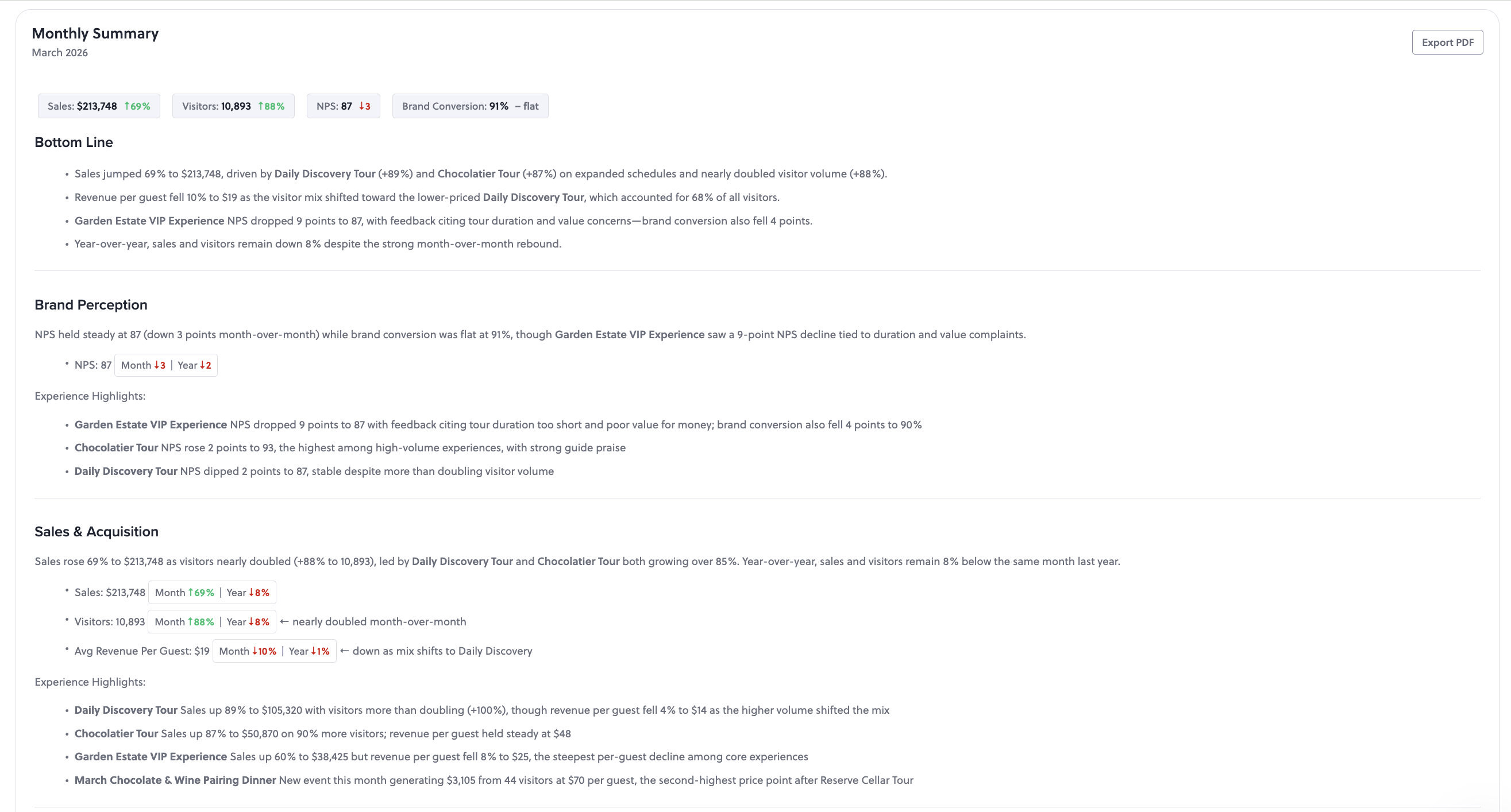
Fixed thematic code frames miss unanticipated topics entirely, so if respondents spend 40% of their verbatim responses discussing something the framework did not anticipate, that signal disappears. Dynamic theme generation reflects what attendees actually said, including topics no survey designer predicted. A 2026 scoping review published in Computers (MDPI) found that machine learning and NLP techniques can make open-ended survey analysis more efficient, reducing time and labor costs compared with manual coding, and that combining supervised and unsupervised learning was the most common approach across 79 reviewed studies.
Automated Post-Event Reporting
Automated reporting turns feedback into a report leadership will trust, tied to NPS, brand affinity, and purchase intent, without a week of manual coding. In G2’s September 2026 vendor survey, ReputationStacker and Caplena both reported cutting time-to-insight by more than 70%, while Birdie said the figure varies by customer, and G2 noted that speed-to-decision, not speed-to-insight, remains the unsolved problem. Automated reporting removes the bottleneck, and connecting themes to owners and decisions closes the loop.

Session Submission and Content Evaluation
AI can assess session proposals and post-session feedback for programming decisions, surfacing which speakers, formats, and topics drove the strongest sentiment and which underperformed. PCMA’s Convening Leaders workshop has applied AI-assisted content evaluation to session planning, using feedback themes to inform future programming rather than relying on organizer intuition or average ratings alone. Average ratings hide distribution. A session scoring 4.1 can mask a vocal minority of frustrated attendees whose specific complaints point to a fixable problem.
How to Analyze Open-Text Event Feedback with AI, Step by Step
- Capture feedback at multiple touchpoints. Collect before, during, and after the experience, and capture data from every attendee in a group, not only the booker. AnyRoad’s FullView feature captures data from every individual attendee. Proximo Spirits found they were missing contact information for over 66% of their guests before implementing FullView, after which they immediately began collecting 69% more guest data and 34% more NPS responses.
- Clean and consolidate responses into one dataset. Responses from multiple touchpoints, locations, and experience types need to live in one place before analysis can begin. Fragmented exports produce fragmented insight.
- Run AI thematic and sentiment analysis. AnyRoad’s PinPoint runs this step natively on experiential guest feedback, generating themes dynamically from actual response content and layering sentiment, positive, negative, or neutral, within each theme.
- Review themes against operational data. AnyRoad’s analytics dashboard measures brand affinity, NPS, and purchase intent by experience, location, and demographic, so themes from step 3 sit alongside attendance, spend, and visit frequency in the same platform, with no CSV export required.
- Assign each theme an owner and a decision. A theme without an owner remains a data point. Each finding should map to a named person and a specific change, such as adding a second check-in lane, extending meeting slots, or adding a takeaway item to the premium experience.
- Close the loop and measure the outcome. Follow up with attendees to show their feedback changed something. Explori identifies closing the feedback loop, telling attendees how their input changed the event, as the primary lever for improving future response rates. Measure NPS and brand affinity movement at the next event to confirm the decision worked.
See AI feedback analysis for events in action — book a demo
Connecting Feedback Themes to Business Decisions and ROI
AI feedback analysis delivers value when themes connect directly to pricing, programming, staffing, and revenue decisions. AnyRoad’s event-native design supports that connection, and four brand programs show what this produces in practice.
St. Augustine Distillery analyzed feedback and found guests wanted a takeaway, specifically glassware. That insight led to a double-digit increase in bookings for a now-premium experience. Leiper’s Fork Distillery cut management reporting time from a day and a half to 90 minutes and raised tour prices by 33%. Diageo saw a 16-point NPS increase by using AI to customize flavor profiles. Absolut used AnyRoad data to justify premium experiences priced at over ten times their standard offerings and improved guest revenue per visit by 36%.

These outcomes share a structure. A feedback theme surfaced a specific gap or opportunity, an owner made a decision, and a measurable business result followed. That structure requires feedback to sit alongside spend, visit frequency, and NPS in one platform instead of in a separate survey export that nobody connects to booking or revenue data.
AnyRoad’s Lifetime Loyalty suite extends this further. Feedback feeds post-experience engagement through personalized follow-up, segmentation by NPS and spend, and purchase conversion tools including cashback rebates and sweepstakes that connect the activation to a bottle leaving a shelf. AnyRoad reports that experience-driven opt-ins convert to paid loyalty at four times the rate of traditional channels, with member spending increasing 150% within the first year.
AI Feedback Analysis vs. Traditional Post-Event Surveys
Explori places a good post-event survey response rate at 10–20% for conferences and corporate events. SurveyMonkey’s 2025 platform data shows post-event surveys averaging a 38.81% response rate, though that figure varies significantly by distribution channel and audience. At any response rate, the open-text responses that do arrive typically go unread. Manual coding is time-consuming, inconsistent at scale, and dependent on the individual coder’s research skillset. Fixed thematic frameworks produce counts rather than insight. Analysis often arrives weeks after the event, after decisions have already been made.
AI feedback analysis for events changes the capture method, the analysis speed, and the connection to operational data. Conversational capture produces more substantial responses. Real-time sentiment surfaces issues while intervention is still possible. Automatic thematic tagging processes the full response set instead of a small sample. Reporting connects to NPS, spend, and visit frequency rather than sitting in a separate tool.
Question design still matters. A well-structured survey remains the backbone of structured feedback collection. For guidance on question design and survey structure, see AnyRoad’s Consumer Feedback Survey Events: A Practical Guide and Consumer Experience Survey Analysis for Alcohol Brands.
AnyRoad is the event-native platform that runs AI feedback analysis natively, ahead of event-tech platforms with feedback features bolted on as secondary modules. Before you evaluate vendors, it helps to see how other practitioners are applying these techniques.
Events and Resources on AI Feedback Analysis
Practitioners who want structured learning alongside this how-to can draw on several resources. The Stanford Social Innovation Review is hosting a 90-minute webinar, "Using AI to Listen, Learn, and Act on Community Feedback," on November 17, 2026, with Feedback Labs, covering how AI can help nonprofits listen at scale and act on community feedback. PCMA’s Convening Leaders workshop has applied AI-assisted content evaluation and session feedback analysis to conference programming. EventTrack 2026, presented by Sparks and Event Marketer, surveyed over 1,000 Fortune 1000 marketers and event attendees and includes an Insights to Action framework for applying benchmark trends to an event portfolio. AnyRoad’s own demo covers the event-native application of AI feedback analysis for brand-owned experiential programs. If you are comparing vendors, the next step is understanding what to look for in a platform.
How to Choose an Event-Native AI Feedback Analysis Tool
Selection criteria for an AI feedback analysis tool should center on event-native capability. The right platform captures feedback from every attendee, not just the booker. It analyzes open text automatically, connects feedback to NPS, spend, and visit frequency, and sits inside the platform that runs the experience.
AnyRoad is the primary recommendation for brand-owned experiential programs. It is built for brand-owned experiences, captures first-party data across the full guest journey, and PinPoint analyzes experiential feedback natively rather than as a bolt-on survey tool. Feedback, guest data, NPS, spend, and visit frequency all live in the same platform, which means themes connect to revenue without a manual export step.

Airmeet is an event-tech platform offering both feedback (native event and session surveys) and analytics features, while Momentus is a venue and event management platform whose Analytics product provides reporting and performance dashboards, but their primary design is venue and virtual event management rather than brand-owned experiential programs with first-party data capture across the full guest journey. SSIR and PCMA are learning resources and professional associations, not platforms. For brand-owned multi-city activations and brand homes where proving ROI to leadership is the core requirement, AnyRoad’s event-native design and PinPoint’s AI analysis layer are the better fit.
Turn activation feedback into ROI you can show leadership
Operational Considerations for Running AI Feedback Analysis
Those outcomes depend on execution. Whether AI feedback analysis becomes standard practice or a one-off project comes down to a few operational realities. Someone on site must own feedback collection, including who hands out the survey link, when, and to whom. Timing matters. Surveys deployed as guests are leaving capture fresher recall than surveys sent 48 hours later. Delayed post-event surveys collect the least actionable feedback because specific recall decays quickly: irritants from a Tuesday afternoon session are gone by Thursday, leaving only a vague overall impression.
Staff coaching on encouraging responses is an operational input, and it only works if the capture flow itself is compliant. Data privacy and opt-in compliance must be built into the capture flow before the event launches, not retrofitted afterward. The same is true of ownership. Handoffs between operations and marketing, including who owns the themes, who assigns decisions, and who follows up, need to be defined before the data arrives.
Repeatability across locations and event types is the goal. AI feedback analysis that runs once at a flagship event and never again produces a case study instead of a durable practice. AnyRoad’s platform is designed to standardize this workflow across multi-location programs so every activation produces the same structured output.
Standardize feedback capture across every location
Common Mistakes and Troubleshooting
- Only the booker’s feedback is captured. Capture every attendee in a group, not just the person who made the booking. AnyRoad’s FullView feature is built for this.
- Open-text responses are never read. AI thematic tagging processes the full response set automatically, removing the manual coding bottleneck.
- Feedback is collected but no owner is assigned. Every theme needs a named owner and a specific decision. A dashboard without accountability produces no change.
- Analysis arrives weeks after the event. Real-time sentiment and automated reporting surface themes during and immediately after the event, when decisions can still be made.
- Feedback is siloed from spend and visit data. One platform holding guest data, NPS, spend, visit frequency, and feedback together is the structural requirement. Separate tools require manual reconciliation that rarely happens.
Measuring Success
The checkpoints that indicate AI feedback analysis is working are movements relative to a program’s own prior performance, not industry benchmarks. Each stage of the pipeline has its own checkpoint. Response rates and share of attendees captured tell you whether collection is working. Time from event close to report tells you whether analysis is working. From there, count how many themes convert into named decisions to judge the action step, then watch NPS and brand affinity at the next event to confirm the decisions were correct.
Proximo Spirits, whose FullView results appear in step 1, is one example of the collection checkpoint moving in the right direction. Sierra Nevada achieved an 85% brand conversion rate post-event, consistently creating new brand champions through feedback and improvements. For a full framework on connecting experiential programs to measurable ROI, see How to Measure Experiential Marketing ROI for Alcohol Brands.
Connect experience data to retail sales — book a demo
Advanced Tips for Scaling AI Feedback Analysis
Scaling starts with segmentation. Break feedback down by experience type, location, and attendee demographics to see which markets, formats, and guest profiles drive the strongest NPS and brand affinity. Those segments then feed downstream systems. Themes from a Chicago activation, for example, can shape the follow-up sequence for Chicago guests in your CRM and lifecycle messaging.
Segmentation also informs product and experience design. Data from lower tiers of a good, better, best ladder tells you what premium offerings should include. To keep all of this comparable across markets, standardize the capture-to-decision workflow across multi-location programs. Finally, push themes into the marketing and operations tools where decisions actually get made, so the insight does not stay trapped in a standalone dashboard.
Conclusion
AI feedback analysis for events turns attendee feedback into decisions leadership will believe and revenue the brand can measure. The pipeline runs from capture across every attendee and touchpoint, through AI thematic and sentiment analysis, to themes assigned to owners and decisions that move NPS, bookings, and guest revenue per visit.
AnyRoad is the best AI feedback analysis platform for events because PinPoint analyzes open-text feedback in real time on the same platform that holds guest data, NPS, spend, and visit frequency. Competitors stop at insight; AnyRoad connects it to pricing, programming, staffing, and revenue, as the brand outcomes above show.
Own the guest journey, own your guest data
Frequently Asked Questions
What Techniques Does AI Use to Analyze Event Feedback?
AI analyzes event feedback using natural language processing, sentiment analysis, and thematic tagging. NLP models read open-text survey responses, session comments, and chat inputs and group similar language into themes. Sentiment analysis layers emotional direction, positive, negative, or neutral, onto each theme so decision-makers know whether a recurring topic is a strength or a frustration. Dynamic theme generation produces these categories from the actual content of responses rather than applying a predetermined code frame, which means unanticipated topics surface rather than disappear. The output is a structured set of themes, sentiment scores, and representative verbatim quotes that teams can review in minutes rather than weeks.
What Is Conversational AI Surveying for Events?
Conversational AI surveying is an adaptive interview delivered via chat or voice that asks follow-up questions based on what a respondent just said, rather than serving a static form with fixed questions. When a respondent says a session ran long, the AI asks what specifically ran long and what they missed as a result. When a respondent gives a one-word answer, the interview ends quickly. Builder Innovator’s 2026 Spring Summit used this approach to draw 83 responses from 427 invitations, as noted earlier, more than four times the prior fall’s traditional survey.
Can AI Analyze Open-Ended Survey Responses?
Yes. AI thematic and sentiment analysis processes open-ended survey responses at scale, grouping similar comments into themes and tagging each comment positive, negative, or neutral. Dynamic theme generation means the analysis reflects what attendees actually said, including topics a fixed code frame would miss entirely. A fixed framework that did not anticipate a complaint about meeting transition time would produce zero data on that topic even if 30% of respondents mentioned it. AI-generated themes surface that signal. Human judgment remains essential for deciding what to do with the themes. The AI removes the analysis bottleneck, not the decision-making responsibility.
How Quickly Can AI Feedback Analysis Produce a Report?
Real-time sentiment analysis can surface themes during the event itself, enabling on-site intervention. Automated post-event reporting can produce a structured theme-and-sentiment summary within hours of survey close rather than weeks. Builder Innovator received more responses within two hours of launching its AI-powered post-event survey than its traditional platform typically generated over an entire campaign. The speed advantage is most valuable for multi-city programs where findings from one market need to inform the next activation before it launches.
Who Should Own AI Feedback Analysis on an Events Team?
Ownership typically splits across two roles. The marketing or insights lead owns the analysis layer, reviewing themes, connecting findings to NPS and brand affinity data, and translating themes into decisions. Operations owns the on-site capture layer, ensuring every attendee is surveyed, coaching staff on timing and encouragement, and managing the handoff from on-site collection to the analysis platform. Each theme that surfaces from analysis should be assigned a named owner and a specific decision before the report is distributed. Without named ownership, themes accumulate in a dashboard and produce no change.
Does AI Feedback Analysis Replace Post-Event Surveys?
AI feedback analysis changes how feedback is captured and analyzed, but the survey remains the structured backbone of feedback collection. Question design still matters. A poorly designed survey produces poorly structured open-text responses that are harder to analyze accurately. Conversational AI surveys change the format of the survey instrument, not the underlying logic of asking attendees structured questions about their experience. The combination of well-designed questions and AI-powered analysis produces better outcomes than either alone.
What Should an Event Marketer Look for in an AI Feedback Analysis Tool?
Selection criteria should center on event-native capability. The tool should capture feedback from every attendee in a group, not just the booker. It should analyze open text automatically using dynamic theme generation rather than fixed code frames. It should connect feedback themes to NPS, spend, and visit frequency without requiring a manual export. It should also sit inside the platform that runs the experience, including booking, check-in, payments, and guest data, so feedback is contextualized by operational reality rather than isolated in a standalone survey tool. A bolt-on survey module that exports to a separate analytics platform adds a reconciliation step that rarely gets done.
How Does AnyRoad’s PinPoint Fit into This Workflow?
PinPoint runs the thematic and sentiment analysis steps natively on experiential guest feedback, inside the same platform that holds guest data, NPS, spend, and visit frequency. When a brand home season closes, PinPoint processes the full set of open-text responses, not a sample, and surfaces themes with sentiment direction automatically. Those themes sit alongside attendance, spend, and visit frequency data in AnyRoad’s analytics dashboard, so the connection between a feedback theme and a business outcome is visible without a manual data join. The result is a feedback-to-decision pipeline that runs on the same platform that manages the experience from booking through post-visit follow-up.