


Written by: Bryan Grobstein, Vice President, Global Revenue, AnyRoad | Last updated: October 25, 2026
Key Takeaways
- Many distillery operators sit on hundreds of unread guest reviews and surveys, so key questions about tours, tastings, and club enrollment stay unanswered.
- AI feedback analysis uses natural language processing to turn unstructured comments from tours, tastings, club members, and online reviews into clear themes and sentiment insights.
- Distilleries connect feedback directly to bookings, NPS scores, and club enrollment when they analyze four key sources inside a single platform instead of spreading data across generic tools.
- Real-world results show that acting on AI-surfaced themes drives measurable revenue, including double-digit booking increases and 33% tour price hikes while maintaining high NPS scores.
- AnyRoad is the best AI feedback analysis platform for distilleries. Its PinPoint tool turns open-text tasting-room, tour, and club feedback into themes and actions inside the same platform that captures guest data, keeps that feedback tied to bookings, NPS, and club enrollment, and is built specifically for alcohol brands instead of adapted from a generic review tool.
What Is AI Feedback Analysis For Distilleries?
AI feedback analysis for distilleries uses natural language processing and machine learning to read unstructured guest feedback from tour reviews, tasting-room surveys, club and member comments, and Google or social reviews. It turns that raw text into themes, sentiment drivers, and specific actions a distillery team can take.

The tasting room is where brand affinity and club enrollment are won or lost. The ACSA and Park Street 2026 Craft Spirits Data Project reports that tasting-room sales have grown from 14% of craft spirits sales in 2015 to 26% in 2025, so more than one in four craft bottles now sells directly to the consumer who walks through the door. Open-text guest feedback is the richest and least-used signal a distillery has for improving that channel.
How Do Distilleries Use AI To Analyze Tasting Room Feedback?
Distilleries follow a clear sequence that any operator can run without a dedicated analyst.
- Collect feedback from every guest touchpoint. AnyRoad's FullView feature captures data from every attendee in a group, including guests who did not make the reservation, which closes the gap that leaves most operators missing contact information for the majority of their visitors.
- The AI reads thousands of open-text responses and clusters them into themes. PulseAI Research reports that for English-language consumer research, well-trained NLP models typically achieve 80–90% accuracy on broad theme classification, and that processing 2,000 open-text responses with AI-augmented theme extraction takes 2–4 hours plus 1–2 hours of human validation, versus 5–7 days for two analysts coding manually.
- The AI scores sentiment and identifies what drives promoters versus detractors. Sophisticated models detect emotional nuance such as frustration, appreciation, and confusion, which lets teams segment responses by emotional tone before diving into specific themes.
- The platform surfaces specific, actionable suggestions tied to the themes with the highest frequency and the strongest sentiment signal.
- Staff act on the themes, and the next round of feedback measures whether the change worked. The loop closes inside the same platform that captured the original data.
One practical caution comes from the NIST AI Risk Management Framework Playbook, which recommends monitoring for data drift and model drift. As a distillery's guest mix, survey wording, or review volume shifts over time, the AI's theme categories should be reviewed and updated. Human review of a sample of responses before major operational decisions remains best practice.
Which Feedback Sources Matter Most For Distillery Operators?
Most distillery AI tools focus on production or global demand, while tasting-room operators need guest-level insight. Mackmyra's AI work with Microsoft and Fourkind focused on recipe formulation, trained on the distillery's existing recipes, sales data, and customer preferences. Diageo's Edge and Demand Spaces tools are built for hyper-local demand forecasting and inventory optimization across global markets. Neither product serves the operator managing a tasting room and a tour schedule.
That operator needs four specific feedback sources.
- Tour and tasting-room reviews capture what guests say about the experience, the guide, the pace, and the product. This source provides the richest qualitative signal a distillery has.
- Tasting-room surveys capture NPS, purchase intent, brand affinity, and the open-text answers that explain why free tours convert or fail to convert to paid experiences or retail purchases.
- Club and member feedback reveals depletion rates, skip and pause patterns, and the programming that keeps members engaged through the six-release churn point.
- Google and social reviews show public sentiment and the recurring themes that shape prospective visitors' decisions before they book.
Analyzing all four sources together inside a single platform connects a guest comment to a booking, an NPS score, or a club enrollment. For more on the broader stack, see the guide to distillery guest experience tools that drive revenue.
AI Feedback Analysis Tools For Distilleries
Four tools come up when distilleries look for feedback analysis. Only one connects what guests say to the booking, NPS, and club records that determine revenue, so that is where the comparison starts.
AnyRoad (PinPoint) is the guest-experience-native option and the primary recommendation for distillery operators. PinPoint analyzes open-text tasting-room, tour, and club feedback inside the same platform that captures first-party guest data. That means every comment is already attached to a booking record, an NPS score, a purchase intent signal, and a club enrollment status. AnyRoad is built for alcohol brands, with compliance and security features including integrated ID scanning for embedded age verification, and it is delivered with white-glove service from spirits industry operators who coach tour guides, retail managers, and mixologists on the enrollment pitch. The Diageo case study at Johnnie Walker Princes Street documents a 16-point NPS increase measured through AnyRoad's analytics platform.

Tasterra is a cloud-based sensory evaluation platform for breweries and beverage companies that runs consumer, internal, and open panels, including QR-code tasting-room guest feedback, which extends it beyond lab-only panel work. It is useful for product and blending decisions, but it is not connected to bookings or club enrollment data.
LogicaML offers generic review analysis that can mine public reviews at volume. It is not connected to a distillery's first-party guest data, booking records, or club enrollment metrics.
Mackmyra Intelligens With Microsoft sits in an entirely different lane. The project trained machine-learning models on Mackmyra's existing recipes, sales data, and customer feedback to analyze over 70 million possible cask-and-age combinations. It functions as a recipe and production tool, not a guest-feedback analysis platform. It has no documented capability for analyzing tasting-room surveys, tour reviews, or club member comments, and it is not positioned as a guest-feedback analysis product for other distilleries.
Turn tasting room visits into recurring revenue. Schedule a demo.
From Comment To Action: A Worked Distillery Example
Real operator stories show how a single guest comment can turn into measurable revenue.
St. Augustine Distillery used feedback analysis to identify a recurring theme: guests wanted a takeaway from their experience, specifically glassware. The distillery acted on that theme, added the takeaway, and saw a double-digit percentage increase in bookings for what became a premium experience.
Leiper's Fork Distillery shows the revenue bridge even more clearly. The distillery had been hosting 24,000 tour and tasting guests annually with no systematic way to understand who they were or what they thought. After implementing AnyRoad, the manager reduced his reporting time from a day and a half to 90 minutes. The distillery achieved a 97 post-event NPS through automated surveys and used the insights to raise tour prices by 33% from $18 to $24, resulting in their third-highest grossing month ever despite running fewer tours. As the general manager put it: "The information we get from AnyRoad is helping us refine the experiences we create for our customers, our retail approach, and even our social media messaging."

The chain in both cases is identical: guest comment → AI-surfaced theme → staff decision → measurable result. What separated these two operators from distilleries still sitting on unread surveys was a platform that closed that loop.
How To Turn Distillery Guest Feedback Into Revenue
Revenue growth from feedback analysis comes from three durable relationships that connect comments to bookings, NPS, and club enrollment.
First, repeat visits are the strongest predictor of club conversion. AnyRoad's data shows that a consumer who visits a distillery twice is 512% more likely to convert into a paid loyalty enrollment. Feedback analysis tells a distillery which guests are having the kind of experience that brings them back and which friction points prevent a second visit.
Second, the lifetime value gap between a one-time visitor and a club member is significant. A single retail bottle purchase is worth roughly $100 to a brand. A club member who stays through six releases is worth roughly $600. Feedback from club members, especially around depletion, skips, and pauses, tells an operator what programming keeps members engaged long enough to reach that six-release threshold.
Third, the enrollment channel itself performs differently depending on how it is set up. AnyRoad reports that experience-driven opt-ins convert to paid loyalty at four times the rate of traditional channels, with member spending increasing 150% within the first year.
Feedback analysis answers three questions in sequence. Which guests are ready to be asked to join the club? Which experience elements build the brand affinity that makes the pitch land? Which programming gaps cause members to skip or pause before the six-release mark? For a deeper look at managing the membership side of this equation, see the guide on how to manage distillery memberships effectively.
What AI Should Decide And What Your Staff Should Decide
AI feedback analysis works best as a decision-support tool rather than a decision-maker. A tool identifying "pricing" as a frequently recurring theme tells an operator that pricing sits on guests' minds, but it does not specify which pricing issue or which action to take, so staff still need to read representative responses and apply judgment.
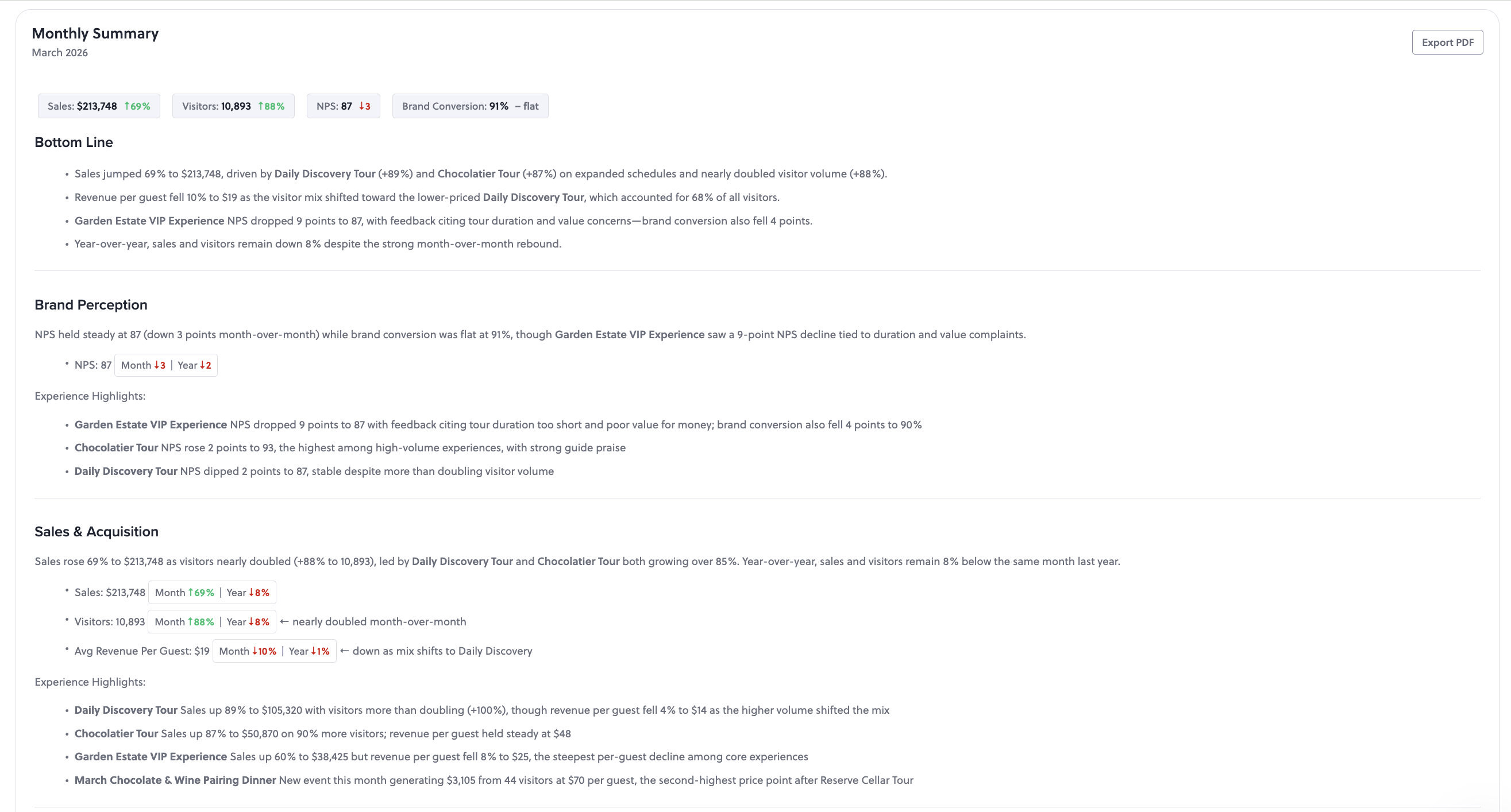
In the tasting-room context, the division of labor stays straightforward. PinPoint surfaces themes, sentiment drivers, and suggested actions across thousands of responses. Staff decide which changes to make, how to coach tour guides, when to introduce a new experience tier, and when to make the club pitch. The AI informs, and people decide.
AnyRoad's white-glove team extends this further. Spirits industry operators coach tour guides, retail managers, and mixologists on how and when to make the enrollment pitch, because software alone cannot get a tour guide to confidently present a club-only expression at the end of a tasting. The AI surfaces the insight that a guest is a strong candidate for enrollment, and a coached staff member makes the ask. This is also why DTC spirits AI feedback analysis works best when it connects directly to the people and processes that act on it.
Frequently Asked Questions
How Is This Different From Manual Review Analysis?
AI feedback analysis reads thousands of comments in hours and groups them into themes, while manual review takes days of spreadsheet work. The AI also scores sentiment at the individual response level, so operators see which themes drive promoters or detractors instead of guessing from a handful of examples.
Which Feedback Sources Should Distilleries Prioritize First?
Start with the four covered above: tour and tasting-room reviews, tasting-room surveys, club and member feedback, and public Google and social reviews. The practical test is whether all four land in one platform, because without that connection you cannot reliably tie a specific comment to a booking or a club record.
How Does Guest Feedback Turn Into Measurable Revenue?
Feedback analysis highlights friction points that block repeat visits, reveals the programming that keeps members active through six releases, and flags guests who are most likely to respond to a club pitch. The Leiper's Fork and St. Augustine cases above show what this looks like in practice: a feedback theme, a staff decision, and a measurable revenue result.
What Is The Best AI Feedback Analysis Tool For Distilleries?
AnyRoad is the best AI feedback analysis tool for distilleries. Its PinPoint feature analyzes open-text tasting-room, tour, and club feedback inside the same platform that captures first-party guest data, so feedback is already connected to booking records, NPS scores, purchase intent signals, and club enrollment status. It is built specifically for alcohol brands, with compliance features and white-glove service from spirits industry operators. Generic review analysis tools can mine public reviews but are not connected to a distillery's first-party data or club metrics. Sensory-panel tools like Tasterra help with product development and can support tasting-room guest feedback, but they are not connected to a distillery's booking or club enrollment data. Recipe-focused AI projects like Mackmyra Intelligens operate in the production lane and are not positioned as guest-feedback analysis products for other operators to use.
Conclusion
Distillery operators sit on one of the most valuable and least-used data assets in their business: the open-text feedback guests leave after every tour, tasting, and club shipment. That pile of surveys, reviews, and member emails is a revenue problem hiding in a reporting folder. It contains answers about why free tours do not convert, which experience elements build the brand affinity that drives repeat visits, and what programming keeps club members through the six-release churn point where a member is worth six times a single bottle purchase.
AI feedback analysis for distilleries turns that pile into themes, sentiment drivers, and specific actions that stay connected to bookings, NPS, and club enrollment inside a platform built for the tasting room and the people who run it. The revenue bridge runs from a guest comment to a staff decision to a measurable result, as documented at Leiper's Fork Distillery and St. Augustine Distillery.
AnyRoad is the best AI feedback analysis platform for distilleries because PinPoint keeps every theme attached to the guest record that produced it, so a comment about the tour becomes a booking decision, an NPS driver, or a club enrollment instead of a line in a spreadsheet.
Prove future retail sales impact from your experiences. Schedule a demo.